


Temple of Pallas
Temple of Pallas
Couldn't load pickup availability
- ✓Shipping with real-time tracking
- ✓Handmade in 4-5 working days
or a special size? • Chat with us
WHY BUY IT
- Magnificent, true-to-life colours
- Adds elegance to any room
- Perfect as a prestigious gift
FEATURES
Print on handmade Amalfi paper
Sheet size: 29 x 42 cm (11.4 x 16.5 in)
Material: artwork printed on very fine handmade Amalfi paper with deckled edges
Print on handmade Amalfi paper with frame
Sheet size: 29 x 42 cm (11.4 x 16.5 in)
With frame: 31 x 44 cm (12.2 x 17.3 in)
Material: artwork printed on very fine handmade Amalfi paper with deckled edges, handmade beech wood frame
The artwork
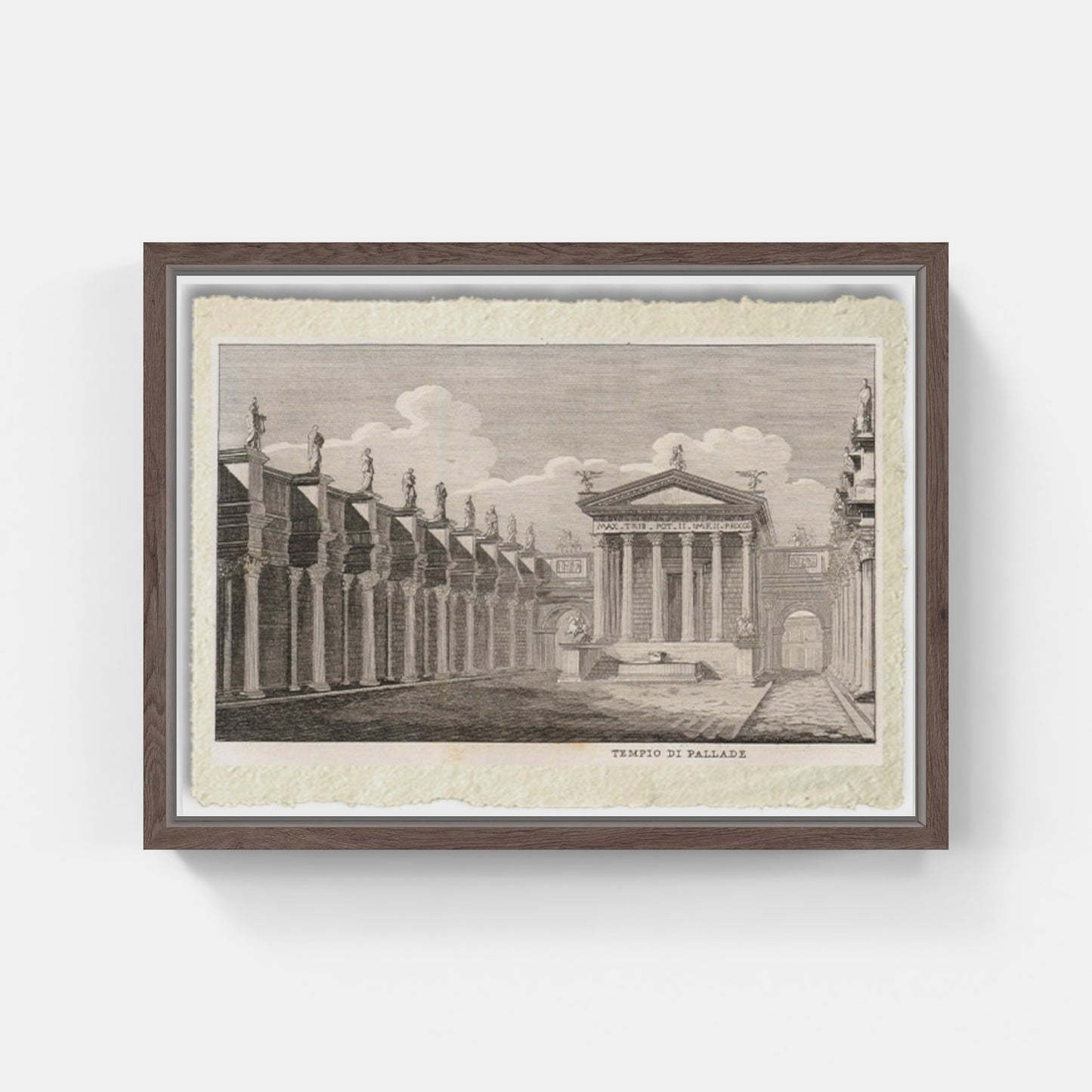
"Foro Transitorio: Tempio di Pallade" by Luigi Canina, dated 1795, is an engraving showing an ideal reconstruction of the Temple of Pallas, located in the Forum Transitorium (or Forum of Nerva) in ancient Rome.
The engraving presents a detailed and symmetrical architectural view, with meticulous attention to the classical elements typical of Roman architecture. The scene is defined by a central perspective that guides the viewer's eye towards the temple itself, at the centre of the composition.
Architectural Elements
1. Columns: the colonnade is imposing, with Corinthian columns. The columns are arranged in a regular sequence that creates an effect of depth.
2. Statues: numerous statues adorn both the top of the colonnade and the pediment of the temple. These figures represent deities and mythological characters, lending an aura of sacredness and majesty to the whole structure.
3. In front of the temple stands an altar, a symbol of the religious ceremonies held there.
The composition uses a central perspective to create a sense of depth, with the lines of the columns converging on the temple. This perspective design accentuates the importance of the temple as the focal point of the scene. The engraving uses chiaroscuro to give relief and dimension to the architectural elements, with lighting that enhances forms and details.
Historical context
The Temple of Pallas, located in the Forum of Nerva, was part of a larger complex that included administrative and civic buildings. The Forum of Nerva, built under the Emperor Domitian and completed by Nerva, was one of the five imperial fora of Rome.
Luigi Canina's work is an excellent example of how 18th-century art sought to revive and understand ancient Rome through detailed reconstructions. His engraving of the Temple of Pallas not only celebrates the grandeur of Roman architecture but also offers a glimpse into the culture and religion of the imperial age, highlighting the link between power, religion and architecture.


Do you have any questions about our works?
How an Amalfi art print is made, what the frame is like, what museum glass is, how long shipping takes, and how returns work: we’ve gathered all the answers on a single page.