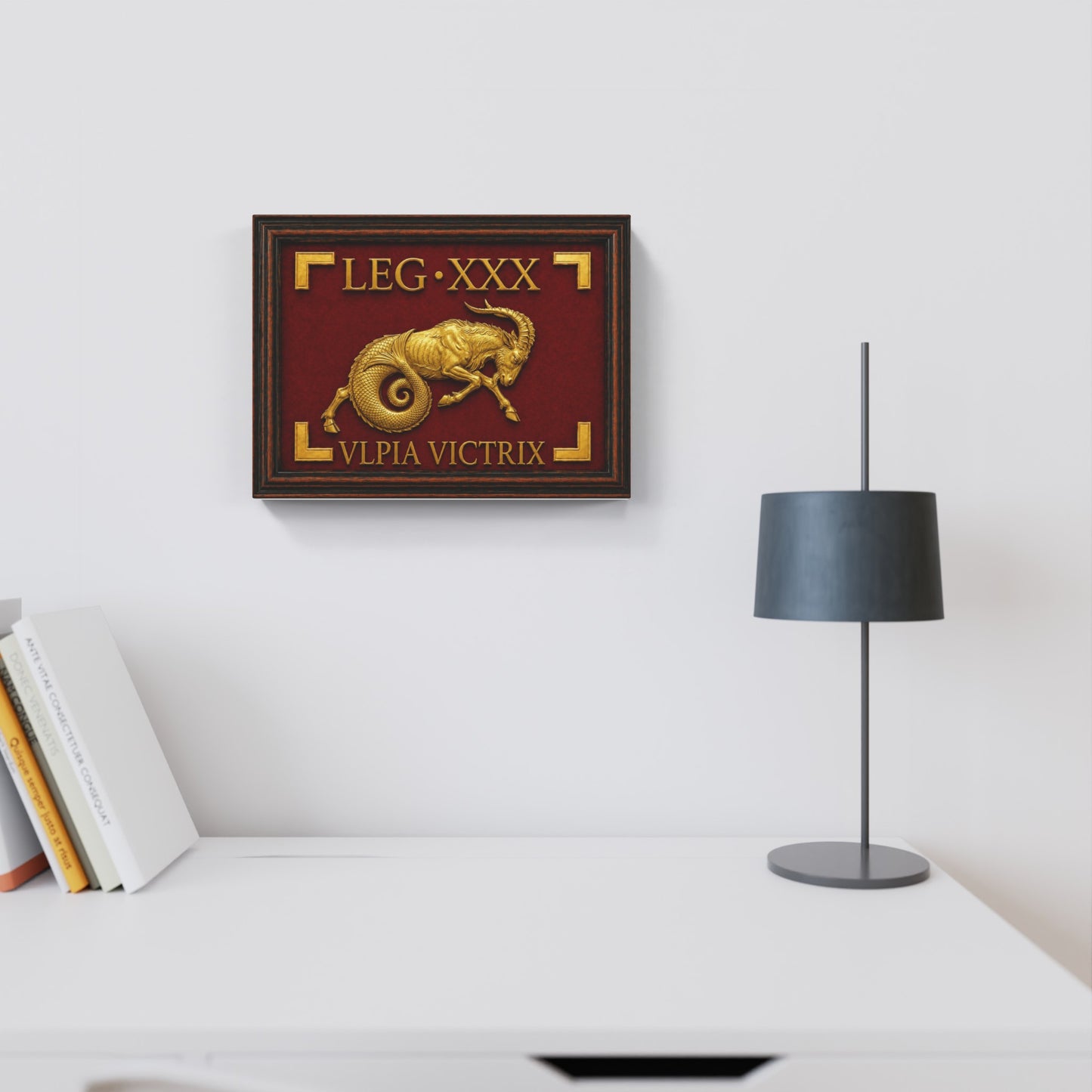


Legio XXX Ulpia Victrix Roman Standard
Legio XXX Ulpia Victrix Roman Standard
Couldn't load pickup availability
- Shipping with real-time tracking
- Handmade in 4-5 working days
or a special size? • Chat with us
The Legio XXX Ulpia Victrix was created by the emperor Trajan in AD 105 for the campaigns in Dacia, together with the II Traiana Fortis. The name Ulpia refers to the gens of Trajan (Marcus Ulpius Traianus), while Victrix ("victorious") was the epithet earned for the valour it showed in the Dacian Wars. The number "thirty" indicates that, at the time of its foundation, the imperial army already counted twenty-nine active legions.
Its first known station was at Brigetio, in Upper Pannonia, on the middle Danube, from where detachments of the legion took part in the final phase of the conquest of Dacia. After the Danubian and Sarmatian wars, the XXX was transferred to the Rhine: from AD 122 it had a permanent base at Colonia Ulpia Traiana (Xanten), in Germania Inferior, a key garrison of the limes and a centre of intense building and administrative activity.
In the 3rd century the legion followed Severus Alexander on his campaign against the Sasanians and then in the operations on the Rhine front. It took part in the conflicts against the Franks and in the events of the Gallic Empire, siding with Postumus and suffering heavy losses when Aurelian restored imperial unity in 274. It survived, as a frontier legion, until the collapse of the Rhine limes in the early 5th century.
HISTORICAL-PHILOLOGICAL STANDARD
-
 Format
40 x 30 cm (15.7 x 11.8 in), balanced and versatile proportions -
 Philological reconstruction
The choice of animal on the standard is based on historical and numismatic sources -
 Colour accuracy
Red inspired by the only surviving original Roman standard, preserved at the Pushkin Museum in Moscow
Product specifications for the banner
Product: Historical-philological standard
Material: print on canvas
Size: 40 x 30 cm (15.7 x 11.8 in)
Technique: inkjet print on canvas
Reconstruction: based on historical, epigraphic and numismatic sources
Installation: supplied with a wooden support so it can easily be hung on the wall
Acrylic product specifications
Product: Historical-philological standard
Material: glossy print on acrylic
Size: 40 x 30 cm (15.7 x 11.8 in)
Technique: high-definition reproduction with brilliant rendering
Reconstruction: based on historical, epigraphic and numismatic sources
Installation: supplied with a hook so it can easily be hung on the wall
Framed canvas product specifications
Product: Historical-philological standard
Material: print on painter's canvas
Size: 40 x 30 cm (15.7 x 11.8 in)
Technique: inkjet print on painter's canvas
Frame: hand-carved walnut wood
Reconstruction: based on historical, epigraphic and numismatic sources