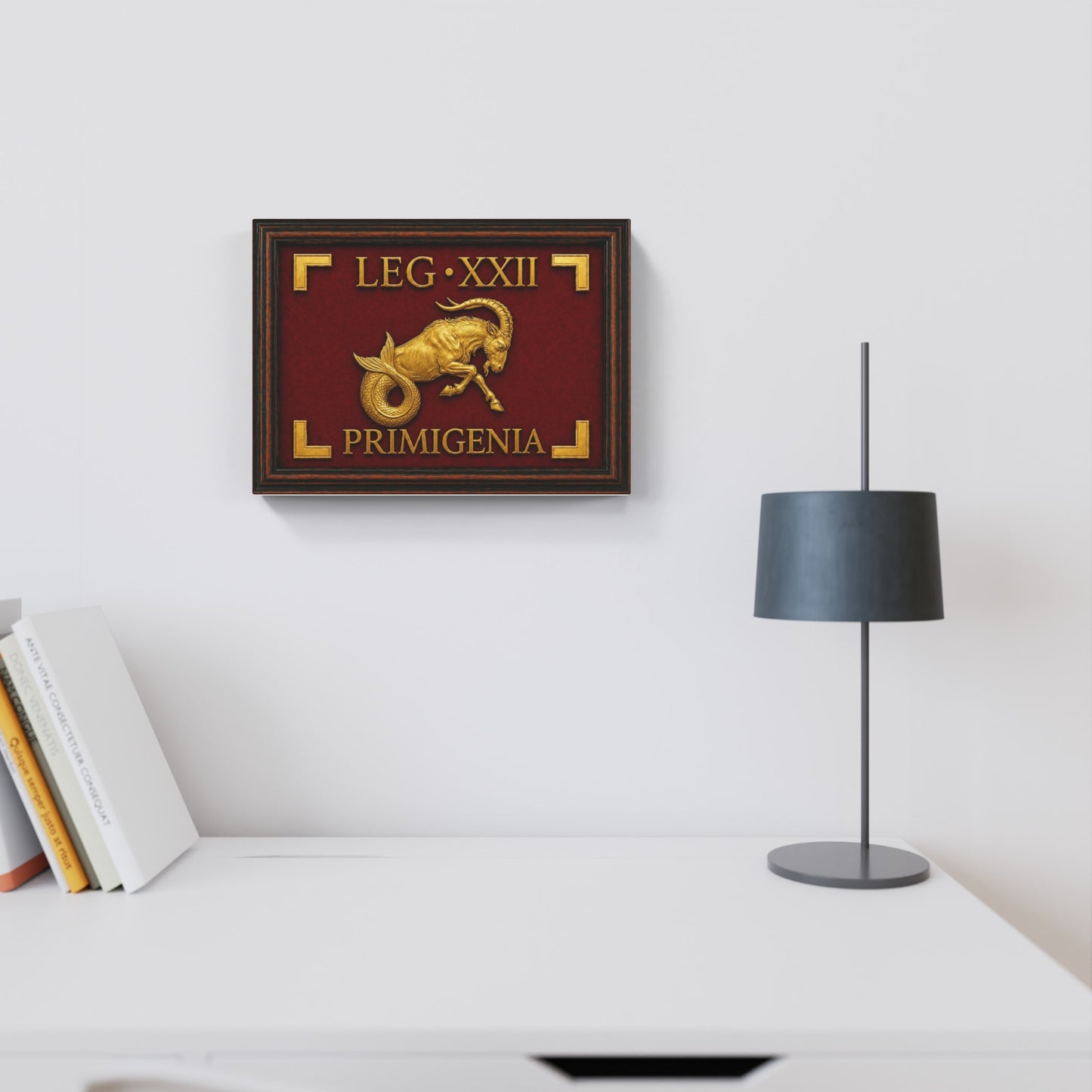


Legio XXII Primigenia Roman Standard
Legio XXII Primigenia Roman Standard
Couldn't load pickup availability
- Shipping with real-time tracking
- Handmade in 4-5 working days
or a special size? • Chat with us
The Legio XXII Primigenia was formed by the emperor Caligula in AD 39 and remained one of the pillars of the Roman army on the Rhine until the early 4th century. Dedicated to the goddess Fortuna Primigenia, it bore the capricorn and the figure of Hercules as its emblems.
Created together with its twin, the XV Primigenia, for a campaign in Germany and perhaps Britain, it was sent along the Germanic limes, with its permanent headquarters at Mogontiacum, today’s Mainz. There the XXII had the task of guarding the Rhine and supporting operations against the Germanic peoples. In AD 69 it backed Vitellius during the Year of the Four Emperors and distinguished itself during the Batavian revolt: under the command of Gaius Dillius Vocula it was the only Germanic legion to hold its camp and continue the defence of Mogontiacum.
Over the course of the imperial age it took part in numerous campaigns, including the Parthian wars and the Marcomannic wars, gaining honorific titles such as Pia Fidelis and, in the Constantinian age, Primigenia CV (probably Constantiana Victrix). In 268 it fought at Naissus against the Goths; the following year its commander Laelianus proclaimed himself emperor of the Gauls, but was quickly defeated by Postumus. The legion is still attested at the beginning of the 4th century, but disappears from the sources after the reign of Constantine, perhaps destroyed in one of the great battles of the period.
HISTORICAL-PHILOLOGICAL STANDARD
-
 Format
40 x 30 cm (15.7 x 11.8 in), balanced and versatile proportions -
 Philological reconstruction
The choice of animal on the standard is based on historical and numismatic sources -
 Colour accuracy
Red inspired by the only surviving original Roman standard, preserved at the Pushkin Museum in Moscow
Product specifications for the banner
Product: Historical-philological standard
Material: print on canvas
Size: 40 x 30 cm (15.7 x 11.8 in)
Technique: inkjet print on canvas
Reconstruction: based on historical, epigraphic and numismatic sources
Installation: supplied with a wooden support so it can easily be hung on the wall
Acrylic product specifications
Product: Historical-philological standard
Material: glossy print on acrylic
Size: 40 x 30 cm (15.7 x 11.8 in)
Technique: high-definition reproduction with brilliant rendering
Reconstruction: based on historical, epigraphic and numismatic sources
Installation: supplied with a hook so it can easily be hung on the wall
Product specifications on canvas framed
Product: Historical-philological standard
Material: print on painter's canvas
Size: 40 x 30 cm (15.7 x 11.8 in)
Technique: inkjet print on painter's canvas
Frame: hand-carved walnut wood
Reconstruction: based on historical, epigraphic and numismatic sources