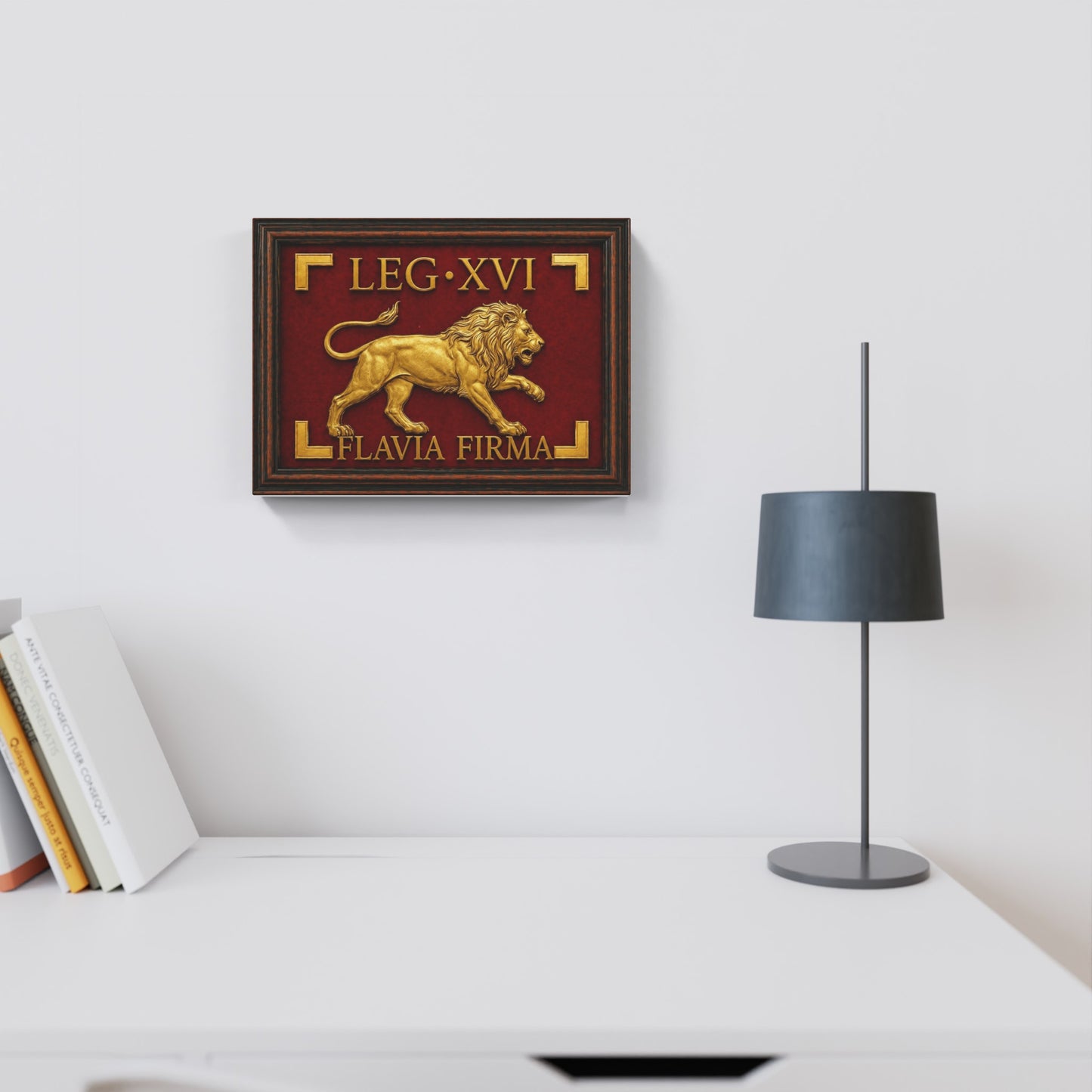


Legio XVI Flavia Firma Roman Vexillum
Legio XVI Flavia Firma Roman Vexillum
o una misura particolare? • Avvia chat WhatsApp
Couldn't load pickup availability
The Legio XVI Flavia Firma ("firm Flavian legion") was a Roman legion created by Emperor Vespasian in 70 AD, incorporating units from the disgraced XVI Gallica, which had surrendered during the Batavian revolt. The cognomen "Firma" meant "steadfast, not fleeing," an honorary title granted to rehabilitate the honor lost by previous soldiers. Its emblem was a winged Pegasus, although some studies also indicate a lion.
After the civil war of the four emperors and the first Jewish war, the XVI Flavia Firma was assigned to the province of Cappadocia from 71 AD, based in Satala to protect the Euphrates border. It remained there until the end of Trajan's principate, participating in his campaigns against the Parthians (114-117 AD).
Under Hadrian, the legion was transferred to Samosata in Syria, where it remained permanently in the following centuries. During the reign of Lucius Verus, it participated in the reconquest of Mesopotamia against the Parthians (161-166 AD). In the 3rd century, it probably fought against the Sassanids during the campaign of Alexander Severus. In the 4th century, it was still encamped in Sura, Syria, tasked with guarding the eastern limes on the Euphrates.
HISTORICAL-PHILOLOGICAL VEXILLUM
-
 Format
40 x 30 cm, balanced and versatile proportions -
 Philological reconstruction
The choice of animal in the vexillum is based on historical and numismatic sources -
 Color fidelity
Red inspired by the only original Roman vexillum preserved in the Pushkin Museum in Moscow
Product specifications on banner
Product: Historical-philological vexillum
Material: print on canvas
Size: 40 x 30 cm
Technique: inkjet printing on canvas
Reconstruction: based on historical, epigraphic, and numismatic sources
Installation: supplied with a wooden support for easy wall hanging
Acrylic product specifications
Product: Historical-philological vexillum
Material: glossy print on acrylic
Size: 40 x 30 cm
Technique: high-definition reproduction with brilliant rendering
Reconstruction: based on historical, epigraphic, and numismatic sources
Installation: supplied with hook for easy wall hanging
Framed canvas product specifications
Product: Historical-philological vexillum
Material: print on artistic canvas
Size: 40 x 30 cm
Technique: inkjet printing on artistic canvas
Frame: hand-carved walnut wood
Reconstruction: based on historical, epigraphic, and numismatic sources