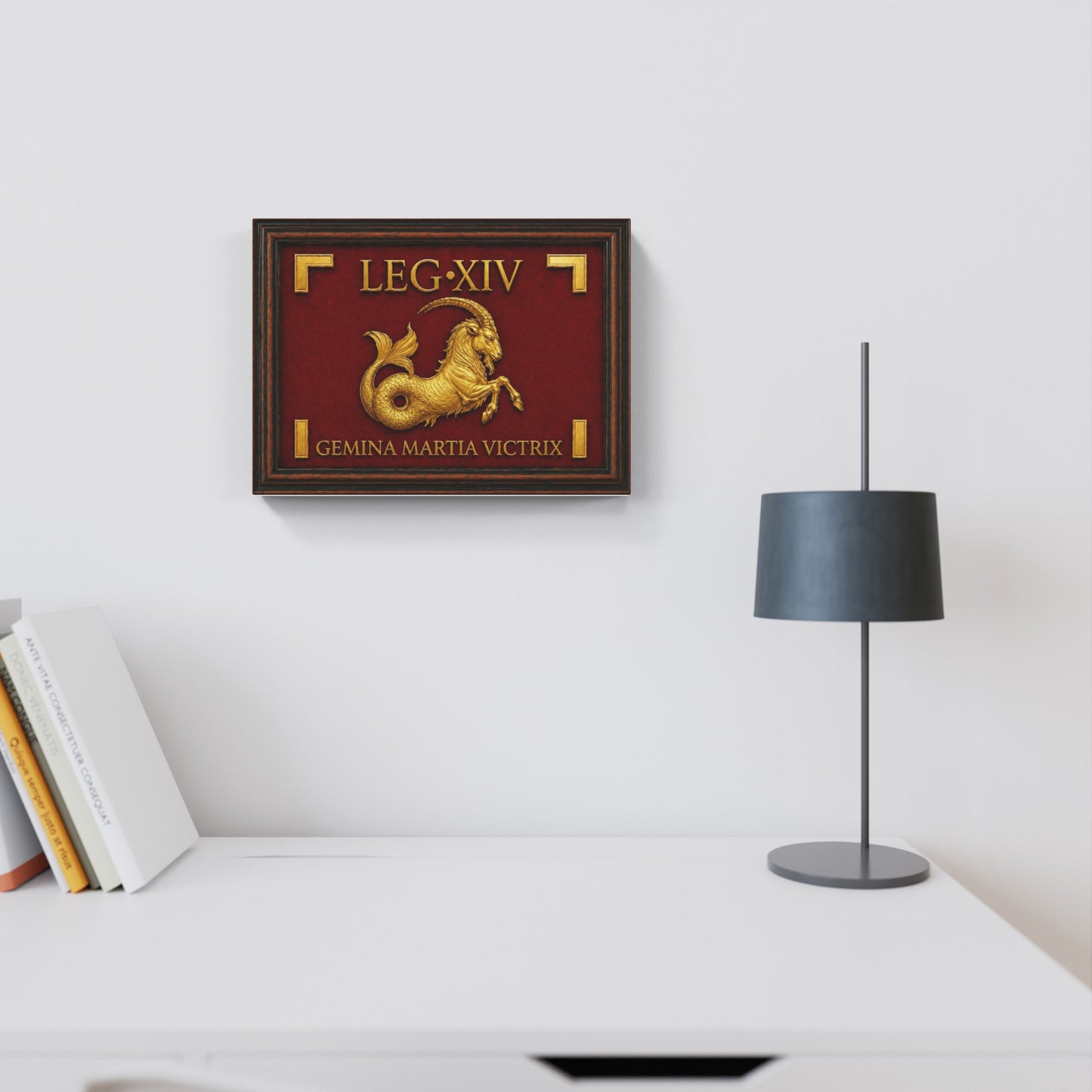


Legio XIV Gemina Martia Victrix Roman Standard
Legio XIV Gemina Martia Victrix Roman Standard
Couldn't load pickup availability
- Shipping with real-time tracking
- Handmade in 4-5 working days
or a special size? • Chat with us
The Legio XIV Gemina Martia Victrix was one of the longest-lived and most prestigious units of the Roman army, with origins in the late Republic and an operational history that extended into the late Empire. The title Gemina indicated the merger of two depleted legions, while the epithet Martia Victrix, linked to the sphere of Mars, extolled its fighting spirit and its victories in battle.
Raised and reorganised within Octavian’s orbit after 41 BC, the XIV was first deployed in the civil wars and in the Gallo-Germanic campaigns, taking part in the operations on the Rhine under Drusus, Tiberius and then Germanicus. With the invasion of Britain in AD 43 it followed Aulus Plautius and Claudius, distinguishing itself in the suppression of the great revolt led by Boudica (60/61), an episode that contributed to its fame as a “martial and victorious” legion.
Under the Flavians and Trajan it was transferred to the Danube, fighting against the Chatti, Dacians, Sarmatians and other frontier peoples, with a permanent base at Carnuntum in Pannonia Superior. In 193 it supported the rise of Septimius Severus, marching on power and then intervening in the civil wars and the Parthian campaigns, confirming itself for centuries as a loyal pillar of the Empire’s Danubian defences.
HISTORICAL-PHILOLOGICAL STANDARD
-
 Format
40 x 30 cm (15.7 x 11.8 in), balanced and versatile proportions -
 Philological reconstruction
The choice of animal on the standard is based on historical and numismatic sources -
 Colour accuracy
Red inspired by the only surviving original Roman standard, preserved at the Pushkin Museum in Moscow
Product specifications for the banner
Product: Historical-philological standard
Material: print on canvas
Size: 40 x 30 cm (15.7 x 11.8 in)
Technique: inkjet print on canvas
Reconstruction: based on historical, epigraphic and numismatic sources
Installation: supplied with a wooden support so it can easily be hung on the wall
Acrylic product specifications
Product: Historical-philological standard
Material: glossy print on acrylic
Size: 40 x 30 cm (15.7 x 11.8 in)
Technique: high-definition reproduction with brilliant rendering
Reconstruction: based on historical, epigraphic and numismatic sources
Installation: supplied with a hook so it can easily be hung on the wall
Framed canvas product specifications
Product: Historical-philological standard
Material: print on painter's canvas
Size: 40 x 30 cm (15.7 x 11.8 in)
Technique: inkjet print on painter's canvas
Frame: hand-carved walnut wood
Reconstruction: based on historical, epigraphic and numismatic sources