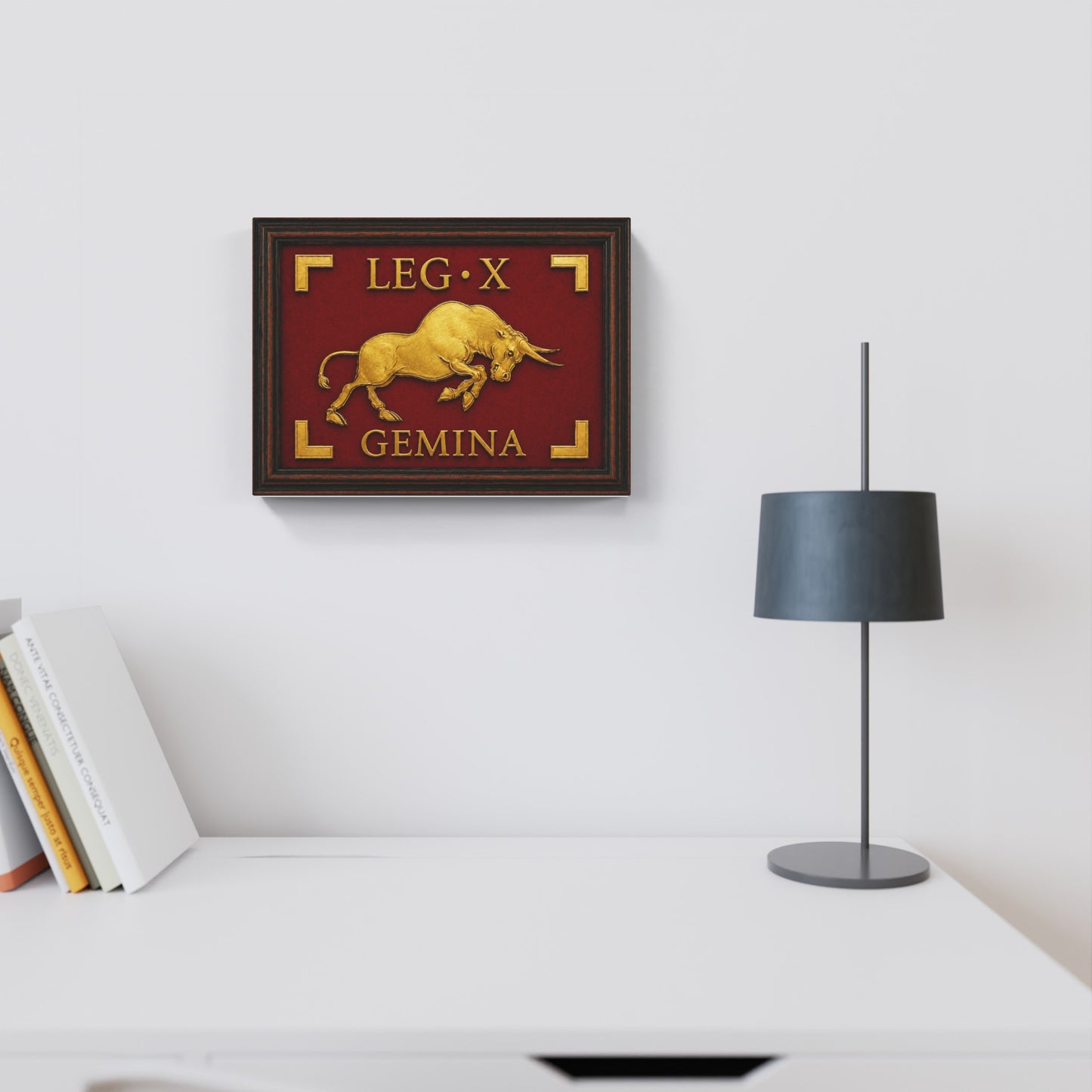


Legio X Gemina Roman Vexillum
Legio X Gemina Roman Vexillum
o una misura particolare? • Avvia chat WhatsApp
Couldn't load pickup availability
The Legio X Gemina has its origins in the legion recruited by Julius Caesar around 59 BC, initially known as Legio X and employed in the conquest of Gaul from 58 to 49 BC.
It participated in Caesar's main campaigns: it fought against the Nervii, took part in the landing in Britannia and the sieges of Gergovia and Alesia, becoming one of the general's most trusted units. It also followed Caesar in the civil wars, distinguishing itself in Spain and in the great battles of Pharsalus (48 BC), Thapsus (46 BC) and Munda (45 BC).
Disbanded after Caesar's victory, it was reformed by Lepidus in 44 BC and then passed under Mark Antony, fighting at Philippi in 42 BC. In the Augustan age, the legion was reorganized and took on the title of "Gemina", indicating its fusion with another eponymous unit. During the Empire, it was deployed on the Rhenish-Danubian fronts; around 103 AD it was stationed in Vindobona (Vienna) to protect the Danubian Limes and participated in Trajan's Dacian campaigns and the Marcomannic Wars. Its history continued until the late empire, when it was probably disbanded or absorbed into other units..
HISTORICAL-PHILOLOGICAL VEXILLUM
-
 Size
Size
40 x 30 cm, balanced and versatile proportions -
 Philological reconstruction
The choice of animal in the vexillum is based on historical and numismatic sources -
 Color fidelity
Red inspired by the only original Roman vexillum preserved in the Pushkin Museum in Moscow
Product specifications for banner
Product: Historical-philological vexillum
Material: print on canvas
Size: 40 x 30 cm
Technique: inkjet print on canvas
Reconstruction: based on historical, epigraphic, and numismatic sources
Installation: supplied with a wooden support for easy wall hanging
Product specifications for acrylic
Product: Historical-philological vexillum
Material: glossy print on acrylic
Size: 40 x 30 cm
Technique: high-definition reproduction with brilliant rendering
Reconstruction: based on historical, epigraphic, and numismatic sources
Installation: supplied with a hook for easy wall hanging
Product specifications for framed canvas
Product: Historical-philological vexillum
Material: print on pictorial canvas
Size: 40 x 30 cm
Technique: inkjet print on pictorial canvas
Frame: hand-carved walnut wood
Reconstruction: based on historical, epigraphic, and numismatic sources