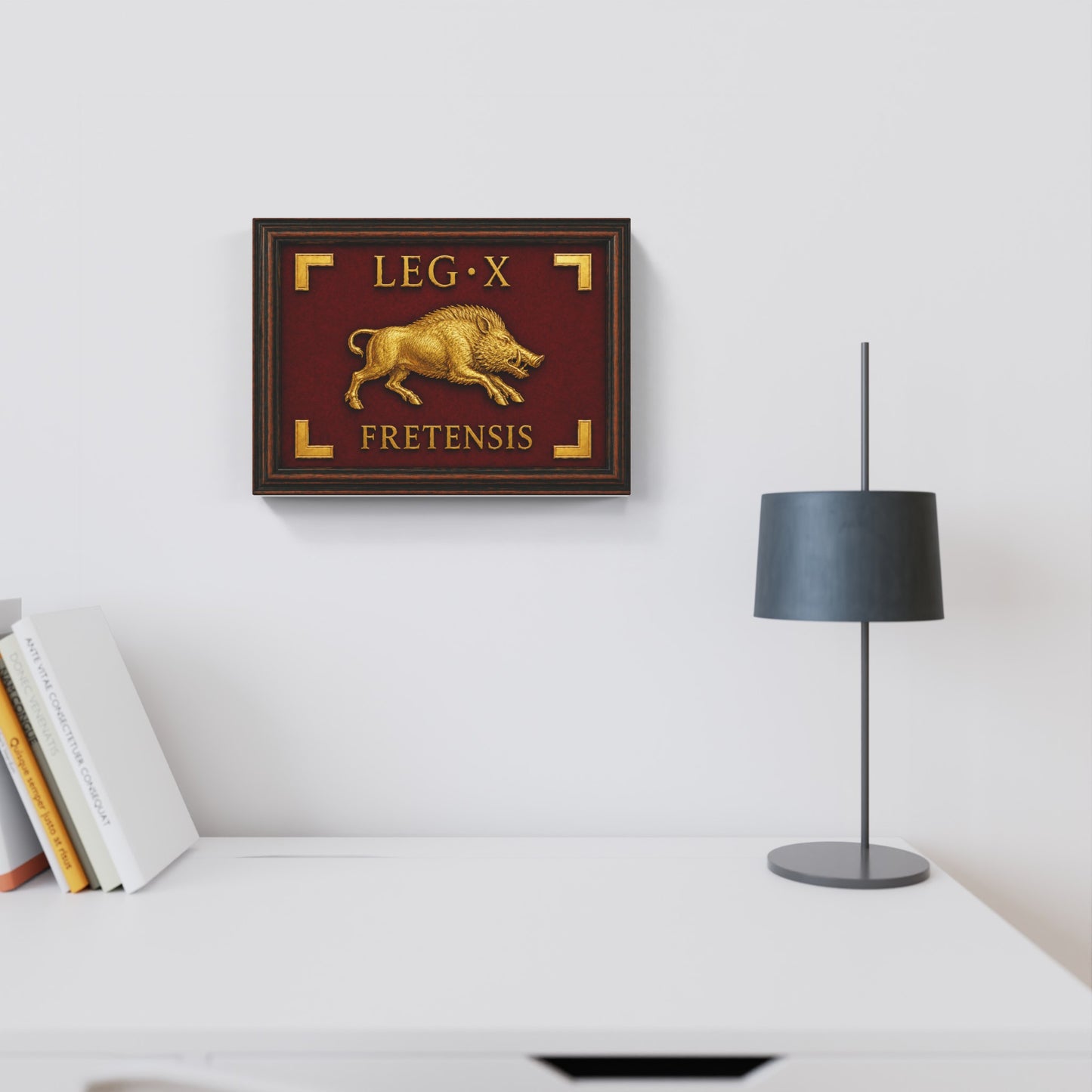


Legio X Fretensis Roman Standard
Legio X Fretensis Roman Standard
Couldn't load pickup availability
- Shipping with real-time tracking
- Handmade in 4-5 working days
or a special size? • Chat with us
The Legio X Fretensis was established by Octavian between 41 and 40 BC to counter Sextus Pompey, who, controlling Sicily, threatened the vital grain routes to Rome.
Its nickname in fact derived from the Fretum Siculum, the Strait of Messina, where the legion secured the naval operations, taking part in the battles of Mylae and Naulochus in 36 BC. The unit’s characteristic emblem was the boar, a symbol of strength and aggression.
Once Augustus’s power was consolidated, the X Fretensis was deployed mainly in the East, taking part in Corbulo’s Armenian campaigns and finally being stationed in Syria and then in Judaea. There it played a central role in the First Jewish War: under Vespasian and Titus it besieged Jerusalem in AD 70, distinguishing itself through the effective use of siege engines during the siege of the Temple. It later contributed to the capture of Masada, where the building of the famous siege ramp sealed the end of Zealot resistance. The legion remained a Roman garrison in Palestine until the 4th century, finally moved to Aila as a policing force in the new province of Palaestina Salutaris.
HISTORICAL-PHILOLOGICAL STANDARD
-
 Format
40 x 30 cm (15.7 x 11.8 in), balanced and versatile proportions -
 Philological reconstruction
The choice of animal on the standard is based on historical and numismatic sources -
 Colour accuracy
Red inspired by the only surviving original Roman standard, preserved at the Pushkin Museum in Moscow
Product specifications for the banner
Product: Historical-philological standard
Material: print on canvas
Size: 40 x 30 cm (15.7 x 11.8 in)
Technique: inkjet print on canvas
Reconstruction: based on historical, epigraphic and numismatic sources
Installation: supplied with a wooden support so it can easily be hung on the wall
Acrylic product specifications
Product: Historical-philological standard
Material: glossy print on acrylic
Size: 40 x 30 cm (15.7 x 11.8 in)
Technique: high-definition reproduction with brilliant rendering
Reconstruction: based on historical, epigraphic and numismatic sources
Installation: supplied with a hook so it can easily be hung on the wall
Framed canvas product specifications
Product: Historical-philological standard
Material: print on painter's canvas
Size: 40 x 30 cm (15.7 x 11.8 in)
Technique: inkjet print on painter's canvas
Frame: hand-carved walnut wood
Reconstruction: based on historical, epigraphic and numismatic sources