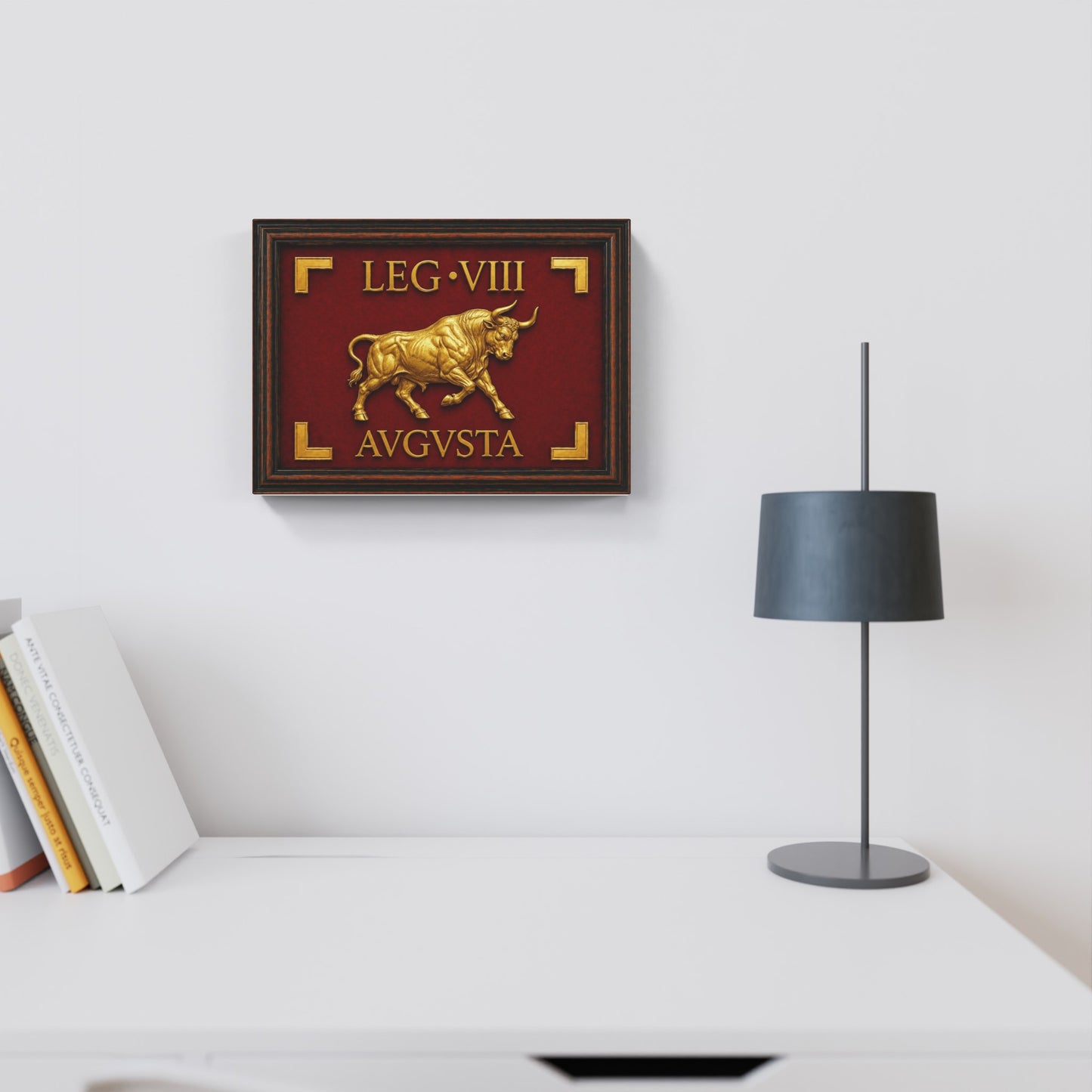


Legio VIII Augusta Roman Vexillum
Legio VIII Augusta Roman Vexillum
o una misura particolare? • Avvia chat WhatsApp
Couldn't load pickup availability
Legio VIII Augusta was one of the longest-serving units of the Roman army, with a history spanning over four centuries of continuous service. Established under Julius Caesar around 59 BC, it was initially deployed in the Gallic Wars, distinguishing itself at Gergovia and Alesia and earning the nickname Gallica for its demonstrated valor. It then participated in the civil war alongside Caesar, fighting at Pharsalus, in Egypt, and at Thapsus.
Temporarily disbanded after 46 BC, it was reorganized by Octavian, who used it in decisive campaigns for control of Rome, such as Mutina, where it earned the epithet Mutinensis. In the imperial age, it was transferred to Poetovio and then along the Danube, obtaining the title Augusta and, after the suppression of the Thracian revolt under Claudius, that of bis Augusta.
After the chaos of the Year of the Four Emperors, the legion finally sided with Vespasian and was transferred to the Rhine, to Argentoratum (Strasbourg), where its main headquarters remained until the 4th century, also participating in Septimius Severus' Parthian campaigns. The latest records show it still active in the 4th–5th centuries, a sign of its very long loyalty in service to the Roman state.
HISTORICAL-PHILOLOGICAL VEXILLUM
-
 Size
Size
40 x 30 cm, balanced and versatile proportions -
 Philological reconstruction
The choice of animal in the vexillum is based on historical and numismatic sources -
 Color fidelity
Red inspired by the only original Roman vexillum preserved in the Pushkin Museum in Moscow
Product specifications on banner
Product: Historical-philological vexillum
Material: print on canvas
Size: 40 x 30 cm
Technique: inkjet print on canvas
Reconstruction: based on historical, epigraphic and numismatic sources
Installation: supplied with wooden support for easy wall hanging
Acrylic product specifications
Product: Historical-philological vexillum
Material: glossy print on acrylic
Size: 40 x 30 cm
Technique: high definition reproduction with brilliant rendering
Reconstruction: based on historical, epigraphic and numismatic sources
Installation: supplied with hook for easy wall hanging
Framed product specifications
Product: Historical-philological vexillum
Material: print on pictorial canvas
Size: 40 x 30 cm
Technique: inkjet print on pictorial canvas
Frame: hand-carved walnut wood
Reconstruction: based on historical, epigraphic and numismatic sources