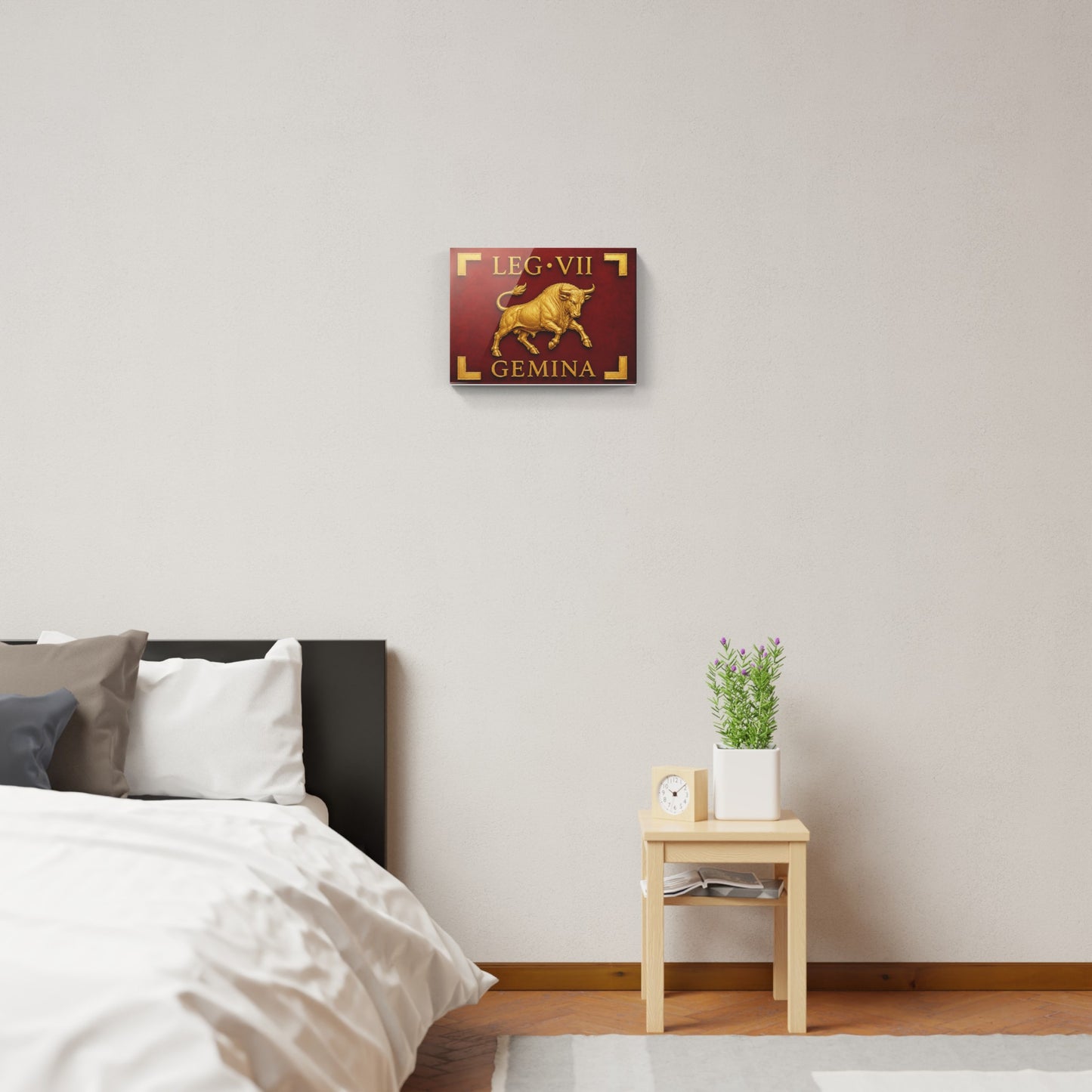


Legio VII Gemina Roman Vexillum
Legio VII Gemina Roman Vexillum
o una misura particolare? • Avvia chat WhatsApp
Couldn't load pickup availability
The Legio VII Gemina was founded in the turbulent Year of the Four Emperors (69 AD), when the governor of Hispania Tarraconensis, Servius Galba, recruited a new legion to march on Rome against Nero. Originally known as VII Galbiana or Hispana, it was reorganized by Emperor Vespasian, who incorporated the survivors of the Legio I Germanica: this "merger" gave rise to the name Gemina, the "twin legion."
After the civil wars and a period of service on the Danube in Pannonia, the VII Gemina was permanently stationed in Hispania, based in Legio, modern-day León, tasked with controlling the rich gold and iron mines of Gallaecia and overseeing the province's main communication routes. The legion earned the nicknames Felix and Pia for its loyalty to the emperors and its good fortune in campaigns. It remained garrisoned in Hispania for centuries, still attested in León at the end of the 4th century, becoming one of the Roman army's most enduring military units and profoundly contributing to the Romanization of the northern Iberian Peninsula.
HISTORICAL-PHILOLOGICAL VEXILLUM
-
 Size
Size
40 x 30 cm, balanced and versatile proportions -
 Philological reconstruction
The choice of animal in the vexillum is based on historical and numismatic sources -
 Color fidelity
Red inspired by the only original Roman vexillum preserved in the Pushkin Museum in Moscow
Product specifications on banner
Product: Historical-philological vexillum
Material: print on canvas
Size: 40 x 30 cm
Technique: inkjet print on canvas
Reconstruction: based on historical, epigraphic, and numismatic sources
Installation: supplied with a wooden support for easy wall hanging
Acrylic product specifications
Product: Historical-philological vexillum
Material: glossy print on acrylic
Size: 40 x 30 cm
Technique: high-definition reproduction with brilliant rendering
Reconstruction: based on historical, epigraphic, and numismatic sources
Installation: supplied with hook for easy wall hanging
Framed canvas product specifications
Product: Historical-philological vexillum
Material: print on pictorial canvas
Size: 40 x 30 cm
Technique: inkjet print on pictorial canvas
Frame: hand-carved walnut wood
Reconstruction: based on historical, epigraphic, and numismatic sources