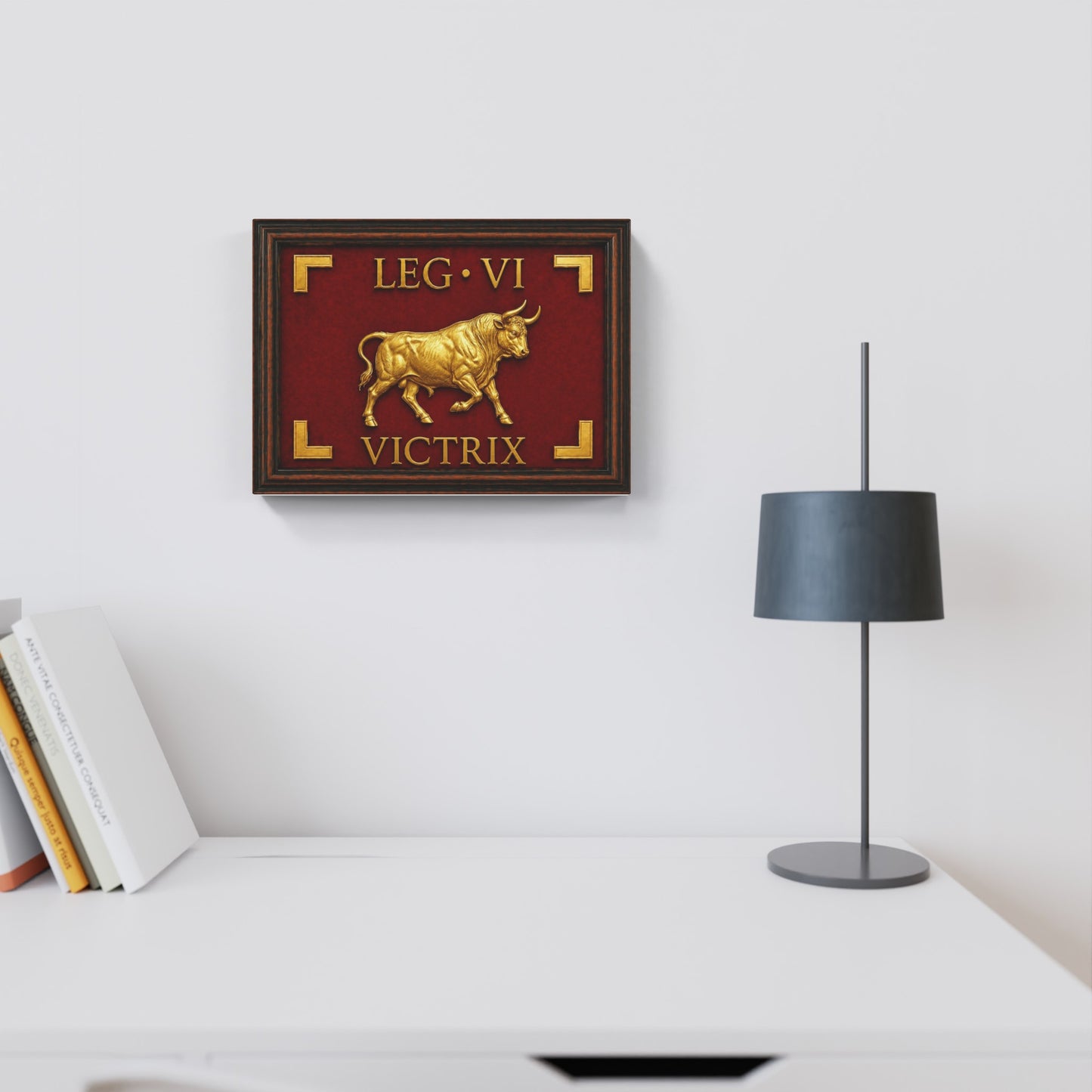


Legio VI Victrix Roman Standard
Legio VI Victrix Roman Standard
Couldn't load pickup availability
- Shipping with real-time tracking
- Handmade in 4-5 working days
or a special size? • Chat with us
The Legio VI Victrix was established by Octavian in 41 BC as the twin of the VI Ferrata, probably by enlisting veterans of Caesar’s campaigns. It saw its first action at the siege of Perusia and fought against Sextus Pompey in Sicily, protecting Rome’s vital grain supplies. In 31 BC it took part in the battle of Actium against Mark Antony and Cleopatra, contributing to the victory that paved the way for the Augustan principate.
Stationed in Hispania with the nickname Hispaniensis, it took part in the hard Cantabrian wars between 25 and 13 BC, consolidating Roman rule over the region. Under Nero and the Flavians it operated along the Rhine, intervening in the suppression of the Batavian revolt and earning the honorific title of Victrix, “victorious”.
In AD 119 Hadrian transferred the legion to northern Britain, where it replaced the IX Hispana at Eboracum (York) and took part in the building of Hadrian’s Wall. It remained there for a long time, supporting usurpers and emperors, until the gradual withdrawal of Roman troops from Britain in the early 5th century.
HISTORICAL-PHILOLOGICAL STANDARD
-
 Format
40 x 30 cm (15.7 x 11.8 in), balanced and versatile proportions -
 Philological reconstruction
The choice of animal on the standard is based on historical and numismatic sources -
 Colour accuracy
Red inspired by the only surviving original Roman standard, preserved at the Pushkin Museum in Moscow
Product specifications for the banner
Product: Historical-philological standard
Material: print on canvas
Size: 40 x 30 cm (15.7 x 11.8 in)
Technique: inkjet print on canvas
Reconstruction: based on historical, epigraphic and numismatic sources
Installation: supplied with a wooden support so it can easily be hung on the wall
Acrylic product specifications
Product: Historical-philological standard
Material: glossy print on acrylic
Size: 40 x 30 cm (15.7 x 11.8 in)
Technique: high-definition reproduction with brilliant rendering
Reconstruction: based on historical, epigraphic and numismatic sources
Installation: supplied with a hook so it can easily be hung on the wall
Framed canvas product specifications
Product: Historical-philological standard
Material: print on painter's canvas
Size: 40 x 30 cm (15.7 x 11.8 in)
Technique: inkjet print on painter's canvas
Frame: hand-carved walnut wood
Reconstruction: based on historical, epigraphic and numismatic sources