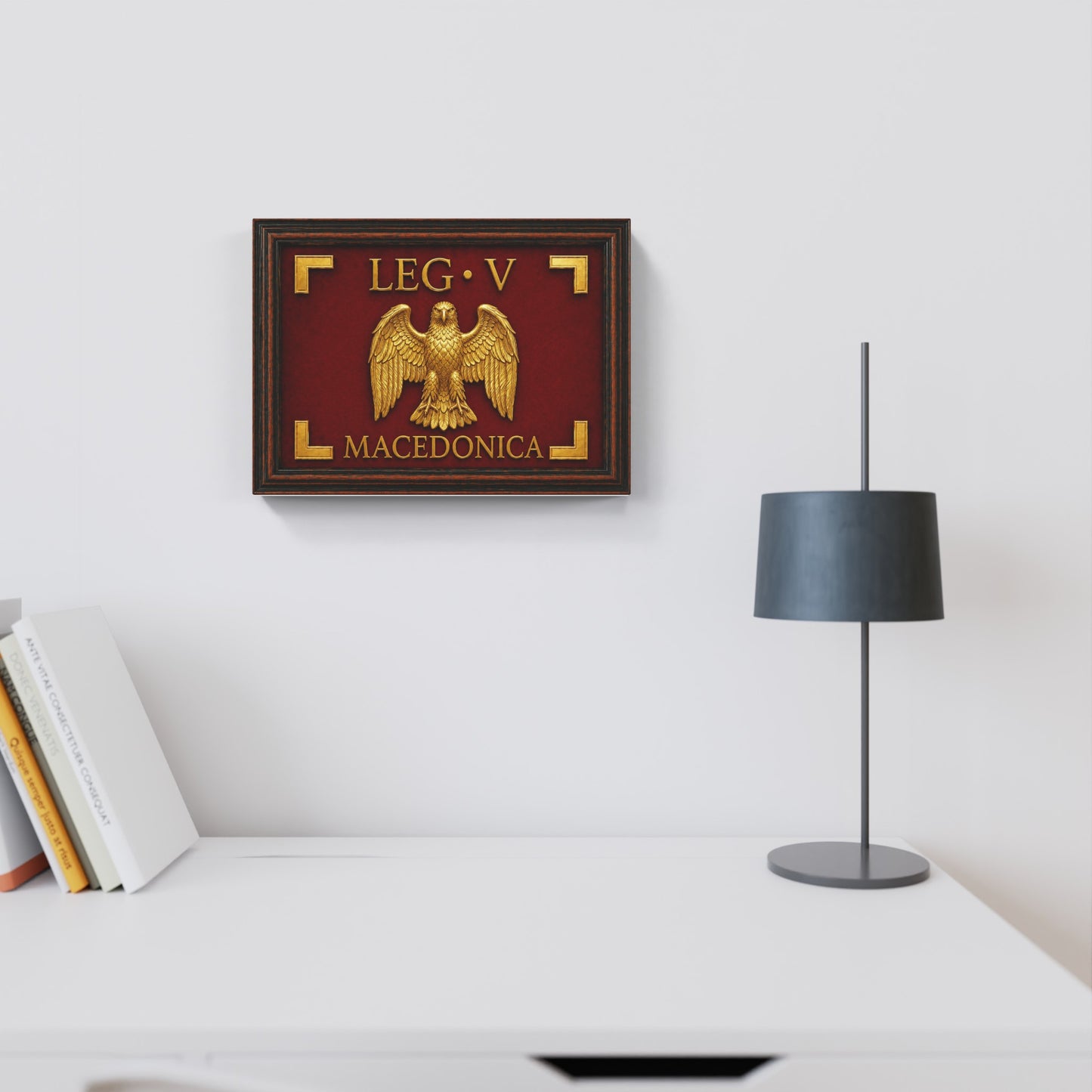


Legio V Macedonica Roman Standard
Legio V Macedonica Roman Standard
Couldn't load pickup availability
- Shipping with real-time tracking
- Handmade in 4-5 working days
or a special size? • Chat with us
The Legio V Macedonica was one of the longest-lived units of the Roman army, active from the late Republic until the Byzantine era.
Founded in 43 BC by the consul Gaius Vibius Pansa and by Octavian, it was among the twenty-eight legions on which the military power of the future Augustus was based. It probably fought at Actium in 31 BC, contributing to the defeat of Mark Antony and Cleopatra, and its veterans were probably settled in north-eastern Italy. The nickname Macedonica derives from its long posting in Macedonia, where the legion was stationed after the civil wars, before its transfer to Oescus in Moesia, on the Danube.
Between the 1st and 2nd centuries AD the V Macedonica took part in Corbulo’s eastern campaigns against the Parthians and, under Trajan, in the Dacian wars, then remained on garrison duty between Moesia and Dacia (Troesmis, Potaissa). Detachments of the legion were deployed in the Jewish wars, in Armenia and in Numidia, testifying to the high regard in which it was held by the imperial command. In the late imperial period a cavalry component joined the mobile eastern field armies for good, and the legion, by then integrated into the Eastern Roman army, probably disappeared in 636, in the defeat at Yarmuk against the Arabs.
HISTORICAL-PHILOLOGICAL STANDARD
-
 Format
40 x 30 cm (15.7 x 11.8 in), balanced and versatile proportions -
 Philological reconstruction
The choice of animal on the standard is based on historical and numismatic sources -
 Colour accuracy
Red inspired by the only surviving original Roman standard, preserved at the Pushkin Museum in Moscow
Product specifications for the banner
Product: Historical-philological standard
Material: print on canvas
Size: 40 x 30 cm (15.7 x 11.8 in)
Technique: inkjet print on canvas
Reconstruction: based on historical, epigraphic and numismatic sources
Installation: supplied with a wooden support so it can easily be hung on the wall
Acrylic product specifications
Product: Historical-philological standard
Material: glossy print on acrylic
Size: 40 x 30 cm (15.7 x 11.8 in)
Technique: high-definition reproduction with brilliant rendering
Reconstruction: based on historical, epigraphic and numismatic sources
Installation: supplied with a hook so it can easily be hung on the wall
Framed canvas product specifications
Product: Historical-philological standard
Material: print on painter's canvas
Size: 40 x 30 cm (15.7 x 11.8 in)
Technique: inkjet print on painter's canvas
Frame: hand-carved walnut wood
Reconstruction: based on historical, epigraphic and numismatic sources