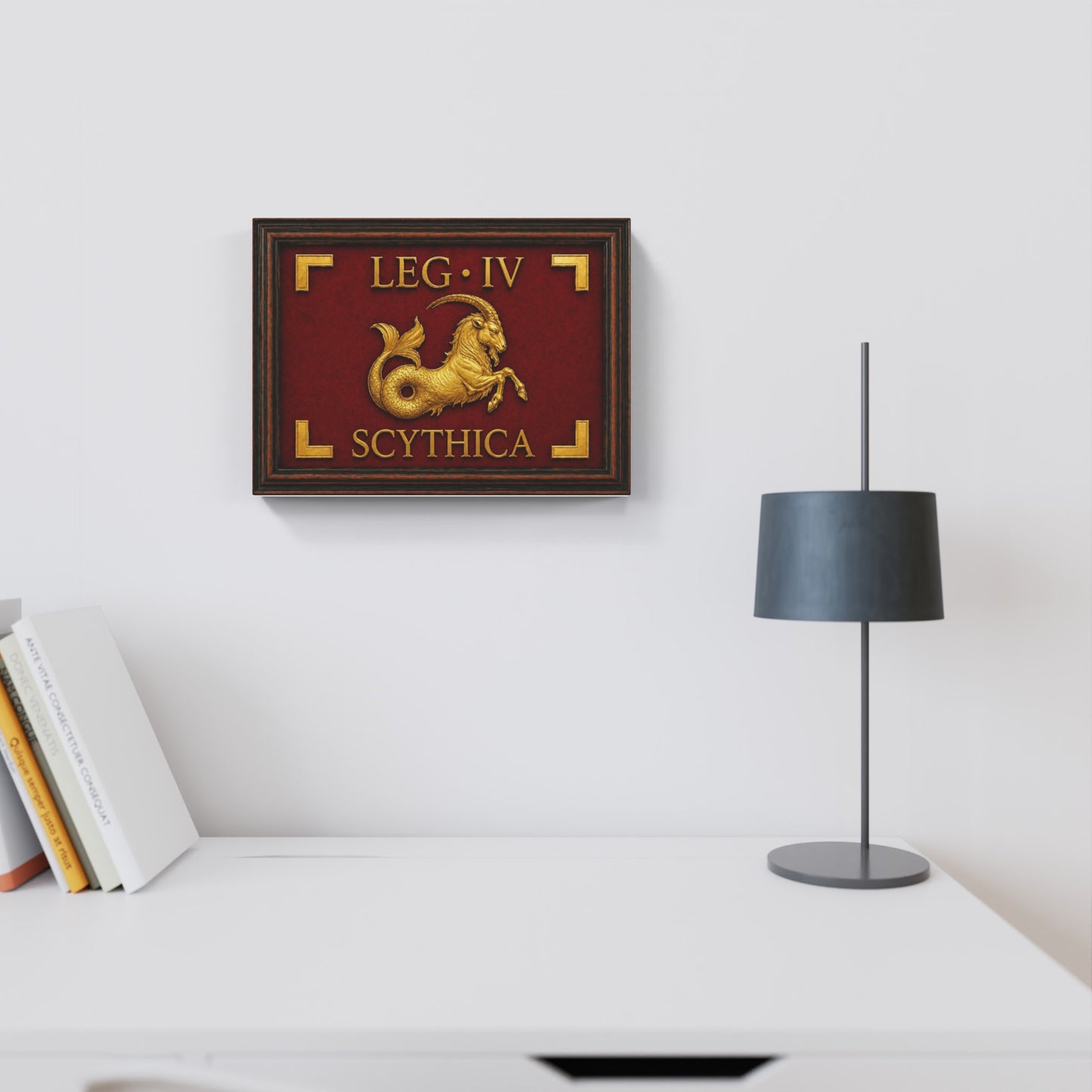


Legio IV Scythica Roman Vexillum
Legio IV Scythica Roman Vexillum
o una misura particolare? • Avvia chat WhatsApp
Couldn't load pickup availability
The Legio IV Scythica was created by Mark Antony around 42 BC for his campaign against the Parthian Empire, from which it also derived the nickname Parthica. The epithet Scythica, on the other hand, refers to operations against Scythian populations stationed in the lower Danube area, where the legion was active in Moesia, probably based in Viminacium. After Actium (31 BC), the IV passed into the service of Augustus, engaged in the fierce fighting of 29-27 BC along the Danube.
Under Nero, the legion was transferred to Syria, with its headquarters in Cyrrhus, participating in the Roman-Parthian wars and suffering the humiliating surrender of Rhandeia in 62. With its reputation compromised, it was excluded from the final victorious phase of Corbulo's campaign. In 69 AD, it supported Vespasian in the civil war, though without fighting directly, and in 70 it was used to suppress an anti-Jewish pogrom in Antioch.
In the 2nd-3rd centuries, it took part in Trajan's campaigns and the wars against the Parthians and Sasanids; between 181 and 183, Septimius Severus was its commander, who later reused it in his eastern conflicts. The Legio IV Scythica was still stationed in Syria at the beginning of the 5th century, with the Capricorn as its distinctive emblem.
HISTORICAL-PHILOLOGICAL VEXILLUM
-
 Format
40 x 30 cm, balanced and versatile proportions -
 Philological reconstruction
The choice of animal in the vexillum is based on historical and numismatic sources -
 Color fidelity
Red inspired by the only original Roman vexillum preserved at the Pushkin Museum in Moscow
Product specifications on banner
Product: Historical-philological vexillum
Material: print on canvas
Size: 40 x 30 cm
Technique: inkjet printing on canvas
Reconstruction: based on historical, epigraphic, and numismatic sources
Installation: supplied with a wooden support to be easily hung on the wall
Acrylic product specifications
Product: Historical-philological vexillum
Material: glossy print on acrylic
Size: 40 x 30 cm
Technique: high-definition reproduction with brilliant rendering
Reconstruction: based on historical, epigraphic, and numismatic sources
Installation: supplied with a hook to be easily hung on the wall
Framed canvas product specifications
Product: Historical-philological vexillum
Material: print on pictorial canvas
Size: 40 x 30 cm
Technique: inkjet printing on pictorial canvas
Frame: hand-carved walnut wood
Reconstruction: based on historical, epigraphic, and numismatic sources