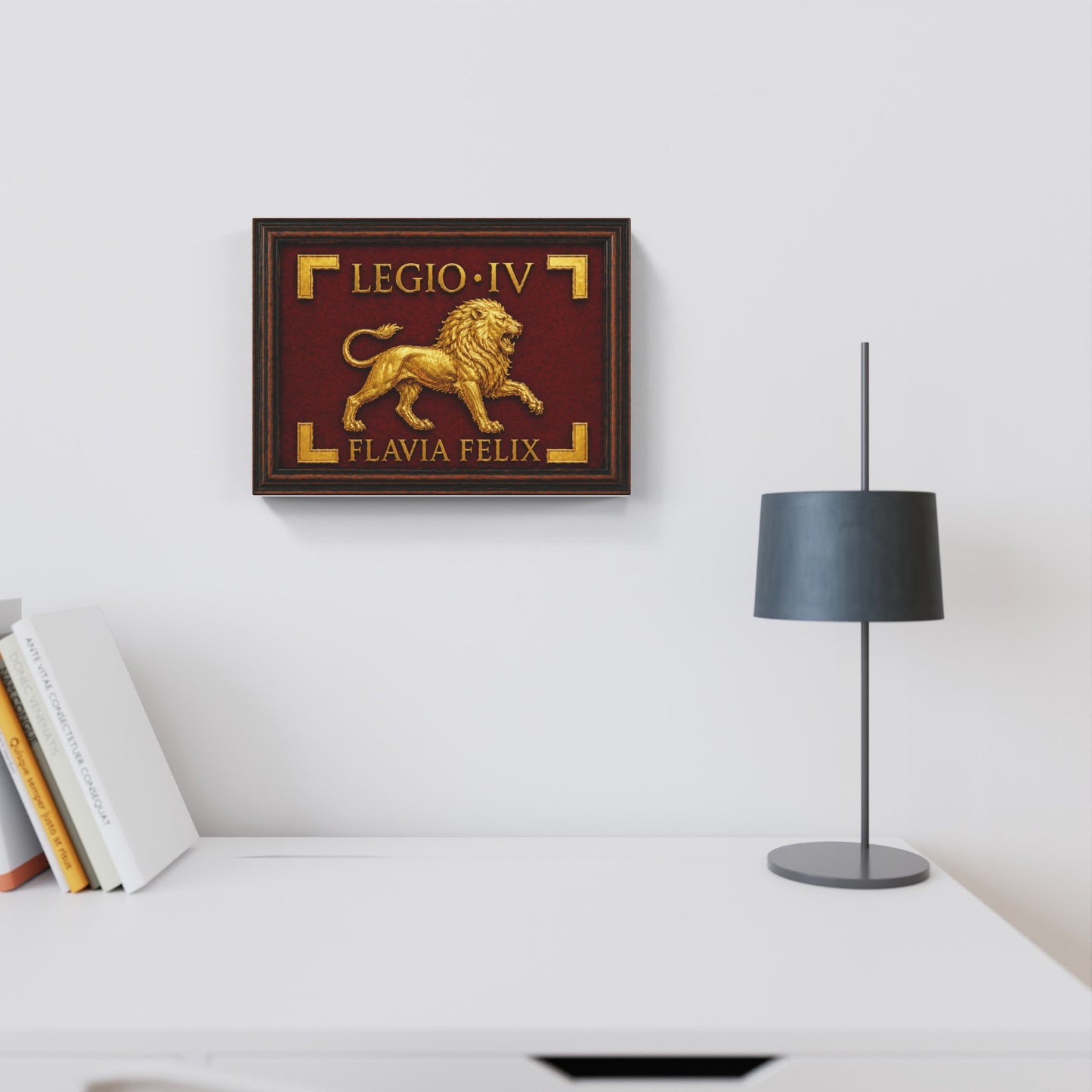


Legio IV Flavia Felix Roman Banner
Legio IV Flavia Felix Roman Banner
o una misura particolare? • Avvia chat WhatsApp
Couldn't load pickup availability
SKU:S4Q9D2K7X5T8M
The Legio IV Flavia Felix was founded by Vespasian in 70 AD, reorganizing veterans of the disbanded Legio IV Macedonica, which had been compromised by its support for Vitellius during the Year of the Four Emperors. The new unit, which bore the name of the imperial gens Flavia and the epithet “Felix” (Fortunate), had the lion as its emblem, perhaps alluding to its founding in July-August.
Stationed along the Danubian limes, it was deployed in Moesia Superior, where it remained operational for centuries as a key garrison against the Transdanubian populations. In 88 AD, it participated in the punitive expedition against Domitianic Dacia and, under Trajan, fought in the Dacian Wars, distinguishing itself at the second Battle of Tapae and in the conquest of Sarmizegetusa. In this context, it built the legionary fortress of Berzobis, which became the nucleus of a Roman urban center in Dacia.
During the Hadrianic era, the legion was transferred to Singidunum, modern-day Belgrade, which gained the status of a municipium and then a colonia, highlighting the role of the IV Flavia Felix in the Romanization of the Danubian area. The unit is attested in Moesia Superior until the early 5th century, a sign of its exceptional longevity in the history of the Roman army.
HISTORICAL-PHILOLOGICAL VEXILLUM
-
 Size
Size
40 x 30 cm, balanced and versatile proportions -
 Philological reconstruction
The choice of animal in the vexillum is based on historical and numismatic sources -
 Color fidelity
Red inspired by the only original Roman vexillum preserved at the Pushkin Museum in Moscow
Product specifications for standard
Product: Historical-philological vexillum
Material: print on canvas
Size: 40 x 30 cm
Technique: inkjet print on canvas
Reconstruction: based on historical, epigraphic and numismatic sources
Installation: supplied with wooden support for easy wall hanging
Product specifications for acrylic
Product: Historical-philological vexillum
Material: glossy print on acrylic
Size: 40 x 30 cm
Technique: high-definition reproduction with brilliant rendering
Reconstruction: based on historical, epigraphic and numismatic sources
Installation: supplied with hook for easy wall hanging
Product specifications for framed canvas
Product: Historical-philological vexillum
Material: print on pictorial canvas
Size: 40 x 30 cm
Technique: inkjet print on pictorial canvas
Frame: hand-carved walnut wood
Reconstruction: based on historical, epigraphic and numismatic sources