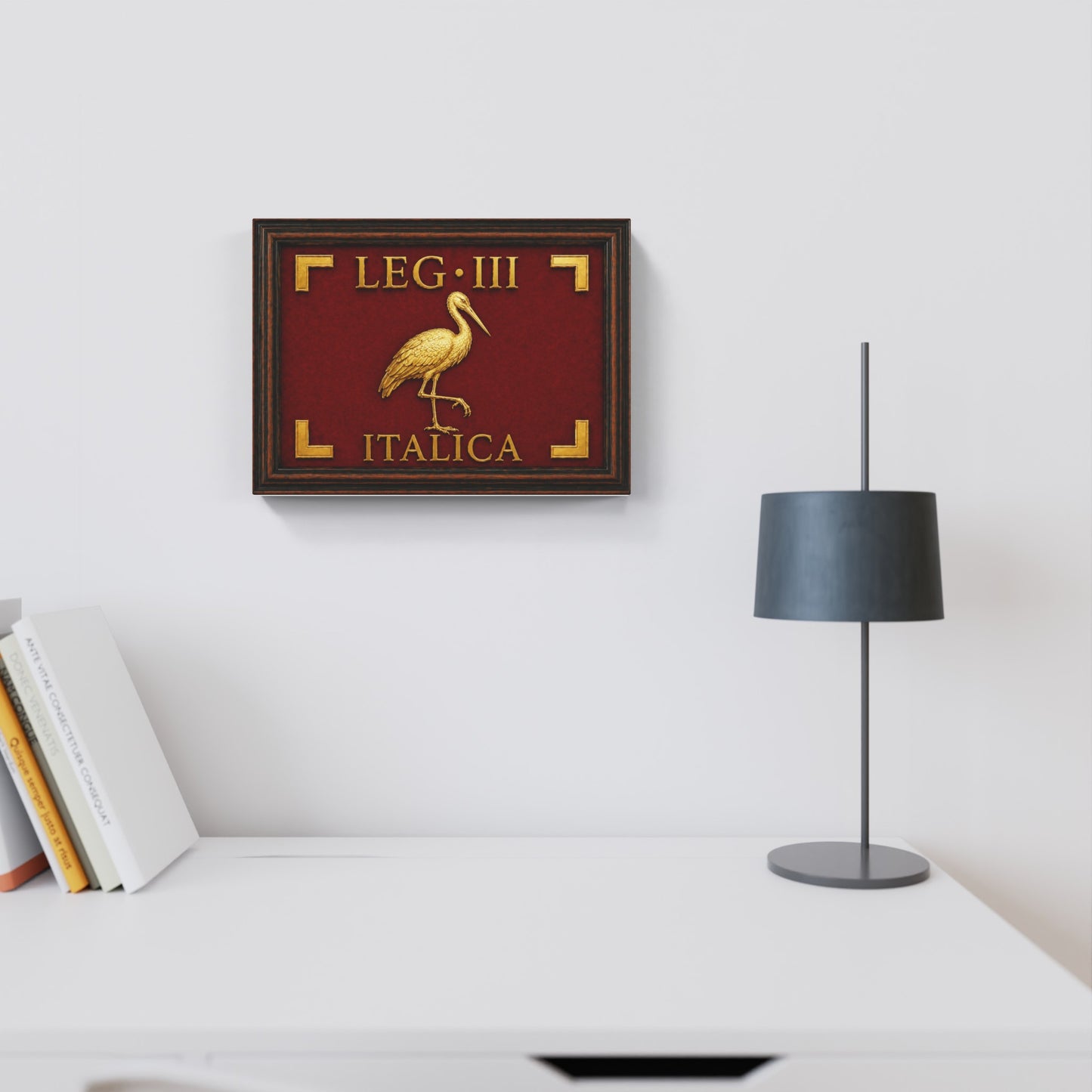


Legio III Italica Roman Vexillum
Legio III Italica Roman Vexillum
o una misura particolare? • Avvia chat WhatsApp
Couldn't load pickup availability
Legio III Italica was created by Emperor Marcus Aurelius around 165 AD, in the midst of the war against the Marcomanni on the Danubian front, probably with Italic recruits destined for the defense of the peninsula.
Its traditional emblem was the stork, a symbol of vigilance and loyalty. Together with Legio II Italica and other Danubian units, it was engaged against the Germanic peoples who had penetrated Raetia and Noricum, contributing to the stabilization of the upper limes. In 171, its legionaries founded the great castrum of Castra Regina, modern-day Regensburg, which remained the legion's main base camp for centuries.
During the civil war of 193, Legio III Italica supported Septimius Severus against Didius Julianus, Pescennius Niger, and Clodius Albinus, aligning itself with the new dynasty. In 213, it followed Caracalla in a victorious campaign against the Alemanni, confirming its reputation as a reliable unit. In the turbulent 3rd century, it supported Emperor Gallienus against his rival Postumus, earning the honorary titles of VI Pia VI Fidelis and VII Pia VII Fidelis, "seven times pious, seven times faithful." As late as the 4th-5th centuries, the legion is attested in Raetia and the Danubian provinces, a sign of its long operational continuity on the northern front of the Empire.
HISTORICAL-PHILOLOGICAL VEXILLUM
-
 Size
Size
40 x 30 cm, balanced and versatile proportions -
 Philological reconstruction
The choice of the animal in the vexillum is based on historical and numismatic sources -
 Color fidelity
Red inspired by the only original Roman vexillum preserved at the Pushkin Museum in Moscow
Product specifications for standard
Product: Historical-philological vexillum
Material: print on canvas
Size: 40 x 30 cm
Technique: inkjet print on canvas
Reconstruction: based on historical, epigraphic, and numismatic sources
Installation: supplied with a wooden support for easy wall hanging
Product specifications for acrylic
Product: Historical-philological vexillum
Material: glossy print on acrylic
Size: 40 x 30 cm
Technique: high-definition reproduction with brilliant rendering
Reconstruction: based on historical, epigraphic, and numismatic sources
Installation: supplied with a hook for easy wall hanging
Product specifications for framed canvas
Product: Historical-philological vexillum
Material: print on pictorial canvas
Size: 40 x 30 cm
Technique: inkjet print on pictorial canvas
Frame: hand-carved walnut wood
Reconstruction: based on historical, epigraphic, and numismatic sources