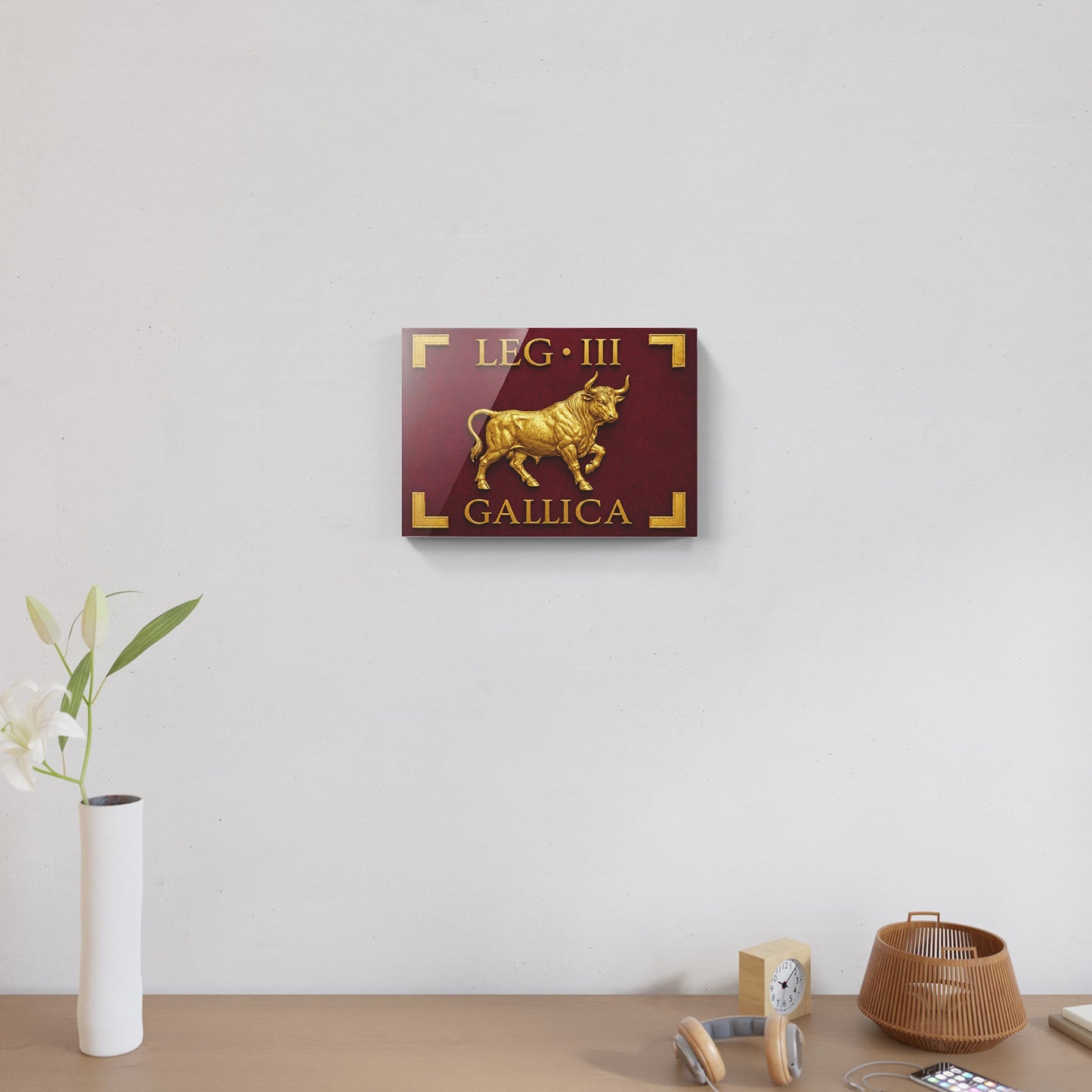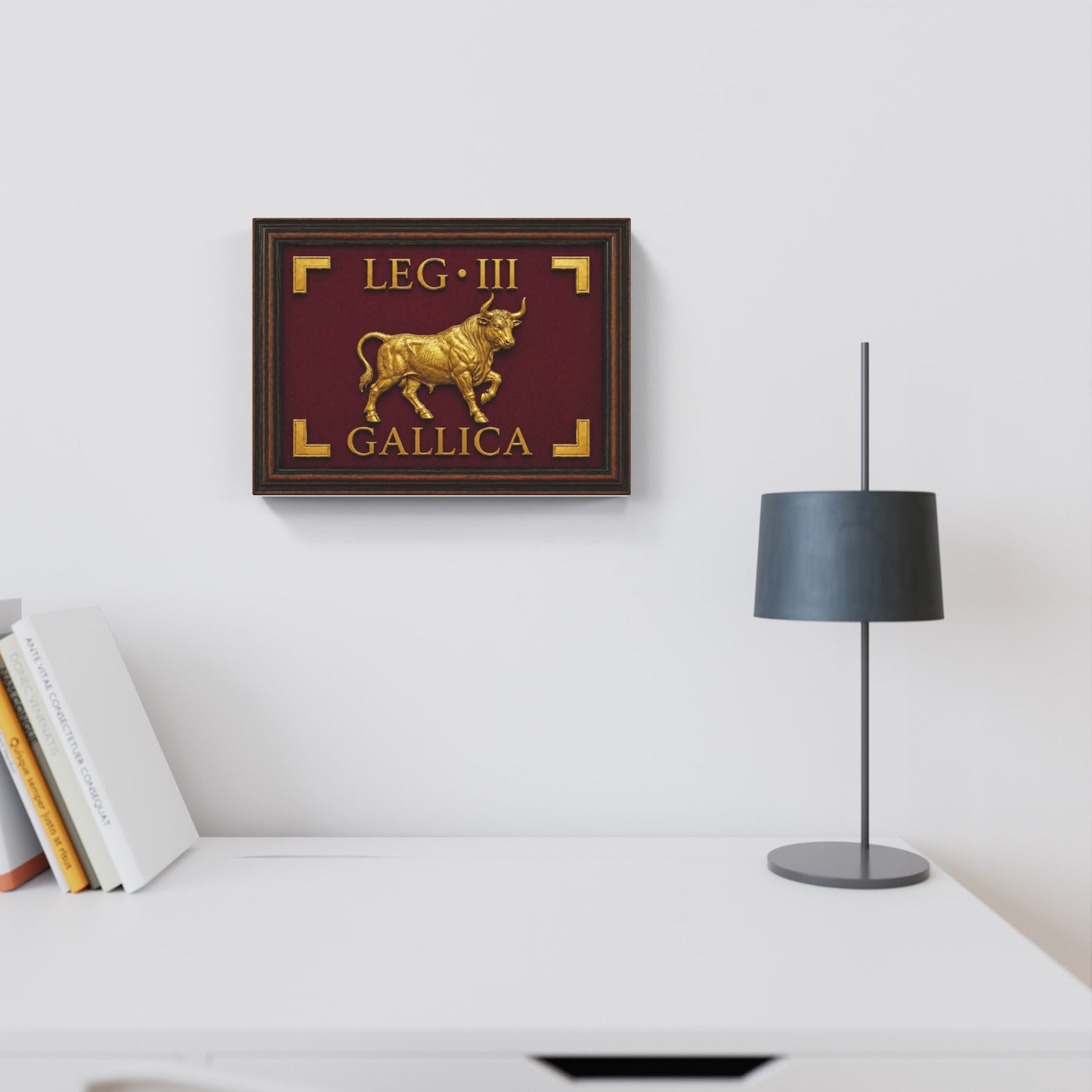


Legio III Gallica Roman Vexillum
Legio III Gallica Roman Vexillum
o una misura particolare? • Avvia chat WhatsApp
Couldn't load pickup availability
Legio III Gallica was created by Gaius Julius Caesar in 49–48 BC for the civil war against Pompey, enlisting veterans from the Cisalpine and Transalpine Gallic provinces.
It fought in all major Caesarian campaigns, distinguishing itself at Dyrrhachium, Pharsalus, and Munda. After Caesar's assassination, it came under Mark Antony, with whom it participated in the Parthian campaign of 36 BC, the only legion explicitly mentioned by Plutarch. After Actium (31 BC), it was integrated into Augustus' army and sent to Syria, where its emblem, the bull, became familiar along the eastern limes.
In the 1st century AD, it played a leading role in Corbulo's Armenian wars against the Parthians and was subsequently transferred to Moesia on the Danube. In 69, the year of the four emperors, the III Gallica supported Vespasian and decisively contributed to the second battle of Bedriacum, with its legionaries' characteristic salute to the rising sun being noted. In the 3rd century, stationed in Emesa, it proclaimed Elagabalus emperor, but shortly thereafter also participated in Verus' revolt, which led to its temporary disbandment. Reconstituted by Alexander Severus and again sent to Syria, it is still attested in the 4th century with detachments in Egypt, bearing witness to a very long operational history in the service of Rome.
HISTORICAL-PHILOLOGICAL VEXILLUM
-
 Size
Size
40 x 30 cm, balanced and versatile proportions -
 Philological reconstruction
The choice of animal in the vexillum is based on historical and numismatic sources -
 Color fidelity
Red inspired by the only original Roman vexillum preserved in the Pushkin Museum in Moscow
Product specifications on standard
Product: Historical-philological vexillum
Material: print on canvas
Size: 40 x 30 cm
Technique: inkjet printing on canvas
Reconstruction: based on historical, epigraphic, and numismatic sources
Installation: supplied with wooden support for easy wall hanging
Acrylic product specifications
Product: Historical-philological vexillum
Material: glossy print on acrylic
Size: 40 x 30 cm
Technique: high-definition reproduction with brilliant rendering
Reconstruction: based on historical, epigraphic, and numismatic sources
Installation: supplied with hook for easy wall hanging
Framed canvas product specifications
Product: Historical-philological vexillum
Material: print on pictorial canvas
Size: 40 x 30 cm
Technique: inkjet printing on pictorial canvas
Frame: hand-carved walnut wood
Reconstruction: based on historical, epigraphic, and numismatic sources