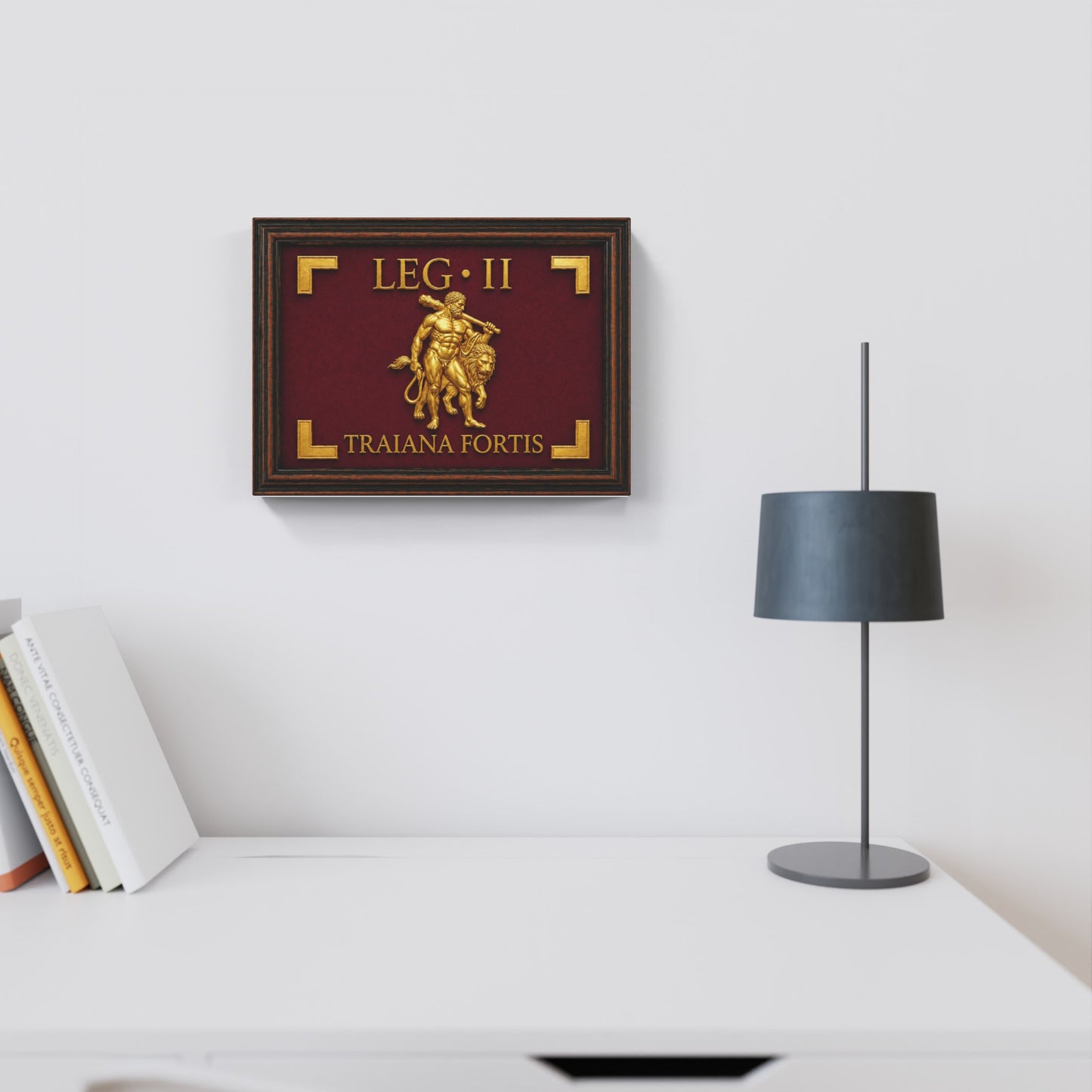


Legio II Traiana Fortis Roman Vexillum
Legio II Traiana Fortis Roman Vexillum
o una misura particolare? • Avvia chat WhatsApp
Couldn't load pickup availability
SKU:D8K2P7T5X9M4Q
The Legio II Traiana Fortis was founded by Emperor Trajan in 105 AD, along with the XXX Ulpia Victrix, for the Dacian campaigns, which concluded with Dacia's annexation to Rome in 106.
Its emblem was the demigod Hercules, a clear reference to strength and military valor. After the victory in Dacia, the legion followed Trajan in the great war against the Parthians, which began in 115, operating on the empire's eastern front.
In 117, it was transferred to Judea to maintain order after local revolts, a role it would continue to play during other periods of provincial unrest. Around 125, the II Traiana was sent to Egypt and stationed in Nicopolis, near Alexandria, sharing the camp with the XXII Deiotariana. During the Bucolic War, when Egypt revolted against Rome, the legion heroically defended Alexandria, enduring hunger and plague until the arrival of Avidius Cassius in 172; for this episode, it earned the cognomen “Fortis”. Even in the 5th century, documents attest to the presence of the II Traiana Fortis in Egypt, bearing witness to its long history of imperial service.
HISTORICAL-PHILOLOGICAL VEXILLUM
-
 Format
40 x 30 cm, balanced and versatile proportions -
 Philological reconstruction
The choice of animal in the vexillum is based on historical and numismatic sources -
 Color fidelity
Red inspired by the only original Roman vexillum preserved in the Pushkin Museum in Moscow
Product specifications for banner
Product: Historical-philological Vexillum
Material: print on canvas
Size: 40 x 30 cm
Technique: inkjet printing on canvas
Reconstruction: based on historical, epigraphic, and numismatic sources
Installation: supplied with a wooden support for easy wall hanging
Acrylic product specifications
Product: Historical-philological Vexillum
Material: glossy print on acrylic
Size: 40 x 30 cm
Technique: high-definition reproduction with brilliant rendering
Reconstruction: based on historical, epigraphic, and numismatic sources
Installation: supplied with a hook for easy wall hanging
Framed canvas product specifications
Product: Historical-philological Vexillum
Material: print on pictorial canvas
Size: 40 x 30 cm
Technique: inkjet printing on pictorial canvas
Frame: hand-carved walnut wood
Reconstruction: based on historical, epigraphic, and numismatic sources