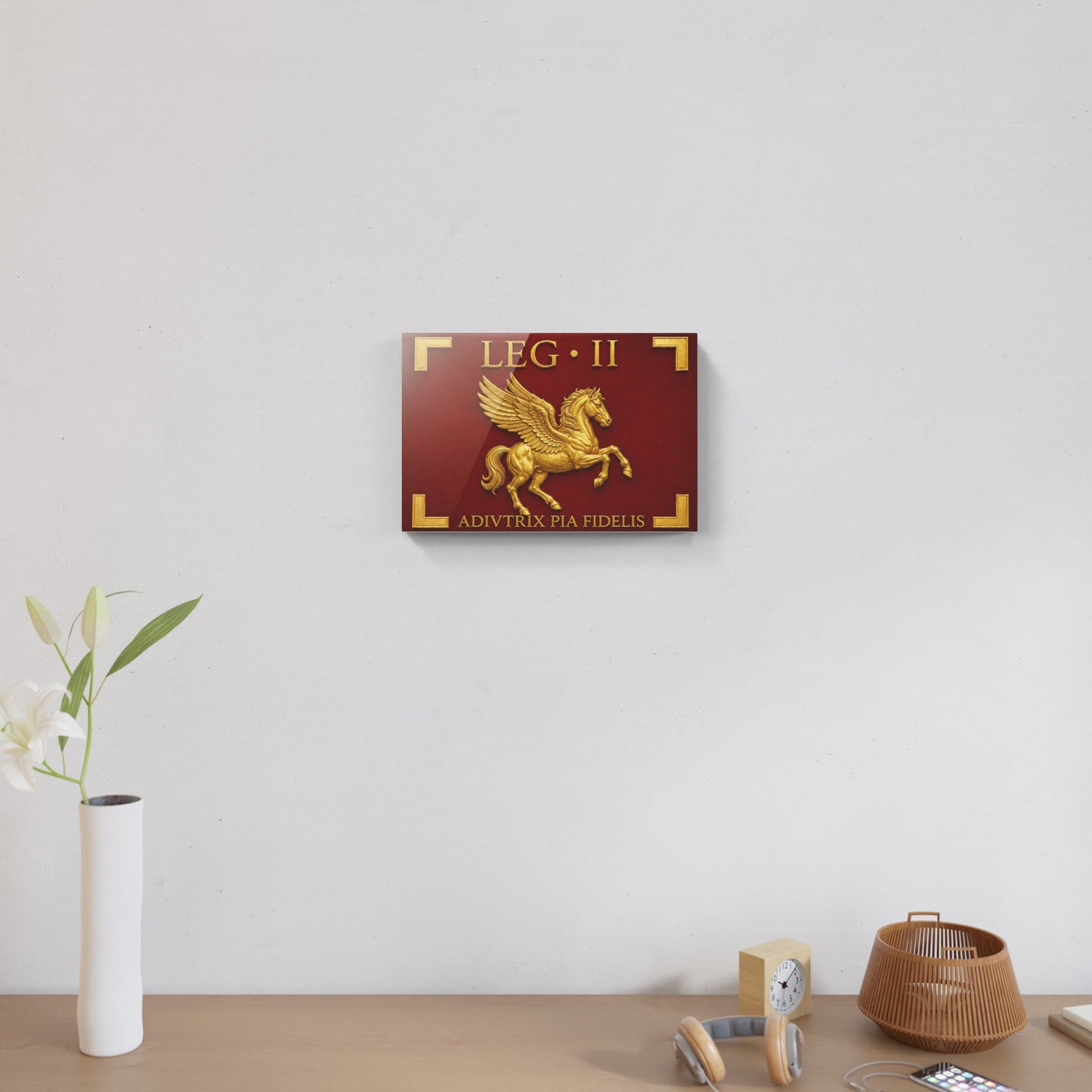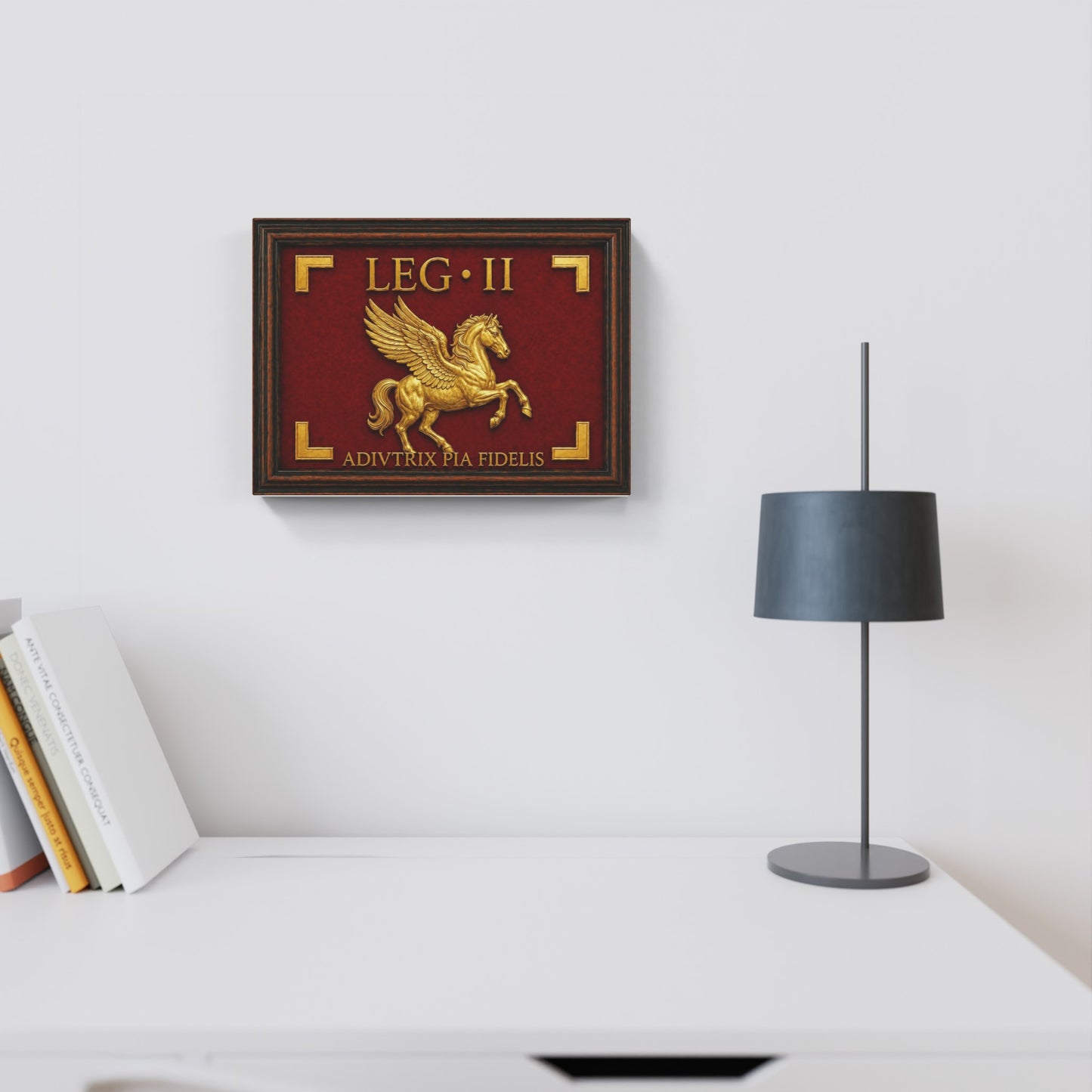


Legio II Adiutrix Pia Fidelis Roman Standard
Legio II Adiutrix Pia Fidelis Roman Standard
Couldn't load pickup availability
- Shipping with real-time tracking
- Handmade in 4-5 working days
or a special size? • Chat with us
Legio II Adiutrix Pia Fidelis was created by the emperor Vespasian in AD 70, enlisting sailors of the Ravenna fleet who had supported him in the civil war against Vitellius, hence the epithet “pia fidelis”.
Its first deployment was the suppression of the Batavian revolt in Germania Inferior, where it fought under Quintus Petillius Cerialis. When the campaign ended, the legion was transferred to Britannia to subdue the Brigantes led by Venutius, stationed between Deva (Chester) and Lindum (Lincoln) and taking part in the subjugation of the tribes of Wales and Scotland.
Recalled to the continent, it took part in Domitian’s Dacian wars, in which the young tribune Publius Aelius Hadrianus also served. It was later permanently deployed in Pannonia, based at Aquincum (present-day Budapest), from where it was employed in the campaigns against the Dacians and Sarmatians and later in the Parthian wars under Lucius Verus. The legion is attested along the middle Danube and on the Rhine until the early 4th century, a sign of a long history of frontier service. Its emblems were Pegasus and Capricorn, symbols of speed and astral protection.
HISTORICAL-PHILOLOGICAL STANDARD
-
 Format
40 x 30 cm (15.7 x 11.8 in), balanced and versatile proportions -
 Philological reconstruction
The choice of animal on the standard is based on historical and numismatic sources -
 Colour accuracy
Red inspired by the only surviving original Roman standard, preserved at the Pushkin Museum in Moscow
Product specifications for the banner
Product: Historical-philological standard
Material: print on canvas
Size: 40 x 30 cm (15.7 x 11.8 in)
Technique: inkjet print on canvas
Reconstruction: based on historical, epigraphic and numismatic sources
Installation: supplied with a wooden support so it can easily be hung on the wall
Acrylic product specifications
Product: Historical-philological standard
Material: glossy print on acrylic
Size: 40 x 30 cm (15.7 x 11.8 in)
Technique: high-definition reproduction with brilliant rendering
Reconstruction: based on historical, epigraphic and numismatic sources
Installation: supplied with a hook so it can easily be hung on the wall
Framed canvas product specifications
Product: Historical-philological standard
Material: print on painter's canvas
Size: 40 x 30 cm (15.7 x 11.8 in)
Technique: inkjet print on painter's canvas
Frame: hand-carved walnut wood
Reconstruction: based on historical, epigraphic and numismatic sources