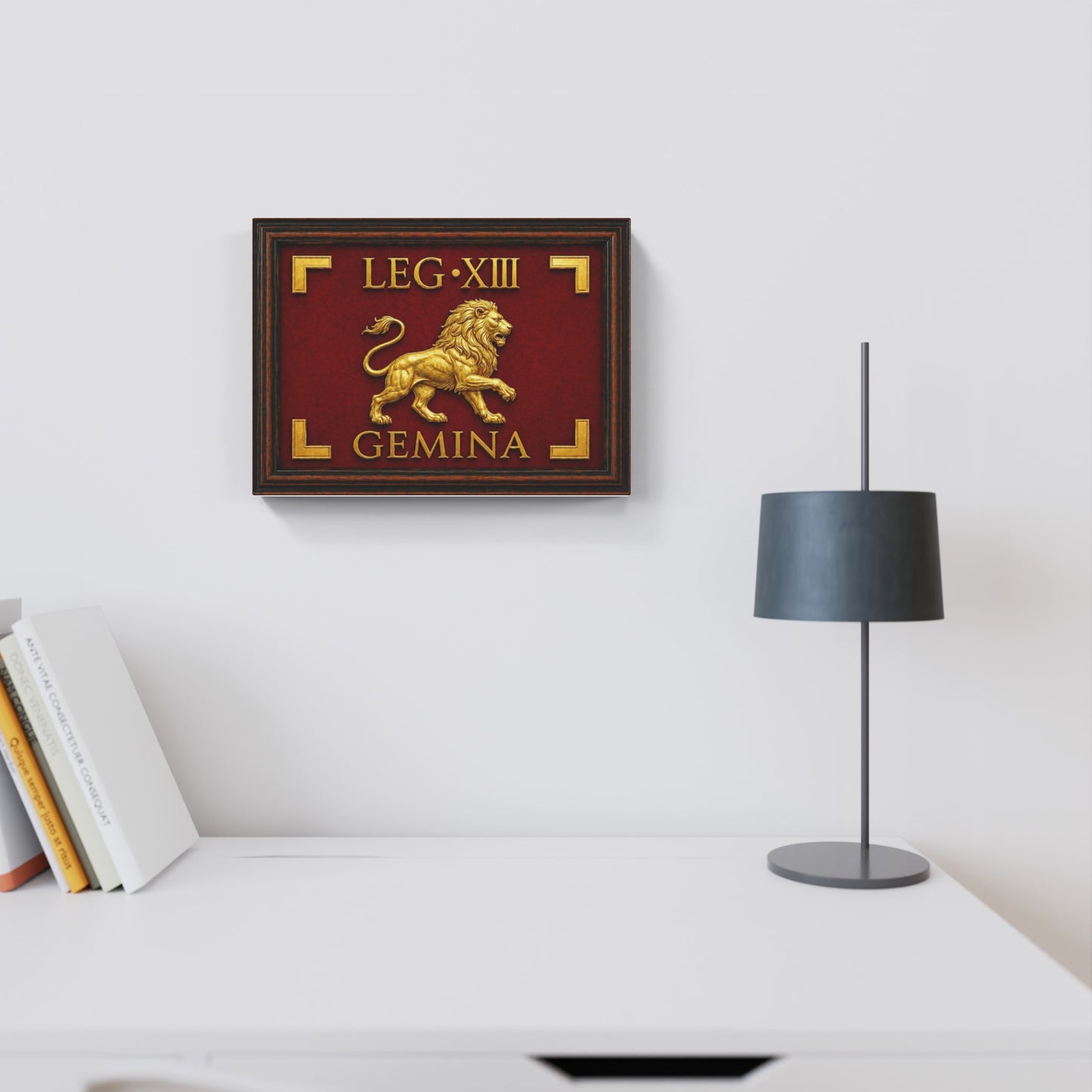


Legio XIII Gemina Roman Standard
Legio XIII Gemina Roman Standard
Couldn't load pickup availability
- Shipping with real-time tracking
- Handmade in 4-5 working days
or a special size? • Chat with us
The Legio XIII Gemina was one of the most famous units of the Roman army, inextricably linked to the figure of Julius Caesar.
It was raised in 57 BC for the campaigns against the Belgic peoples of Gaul, taking part in the operations at the Sabis, at Gergovia and, in all likelihood, at the siege of Alesia. It was with this legion that Caesar crossed the Rubicon in 49 BC, beginning the civil war against Pompey, during which the unit remained ever loyal to its commander until the victory at Pharsalus.
Disbanded at the end of the conflict, it was re-formed by Octavian in 41 BC to face Sextus Pompey and then received the nickname Gemina, because it was reinforced with veterans from other legions after the war against Antony and the battle of Actium. In the imperial age it was sent to garrison Illyricum, then Pannonia and finally Dacia, based at Apulum (today’s Alba Iulia), where it remained for centuries as a pillar of the Danubian limes until the last records in the 5th century AD.
HISTORICAL-PHILOLOGICAL STANDARD
-
 Format
40 x 30 cm (15.7 x 11.8 in), balanced and versatile proportions -
 Philological reconstruction
The choice of animal on the standard is based on historical and numismatic sources -
 Colour accuracy
Red inspired by the only surviving original Roman standard, preserved at the Pushkin Museum in Moscow
Product specifications for the banner
Product: Historical-philological standard
Material: print on canvas
Size: 40 x 30 cm (15.7 x 11.8 in)
Technique: inkjet print on canvas
Reconstruction: based on historical, epigraphic and numismatic sources
Installation: supplied with a wooden support so it can easily be hung on the wall
Acrylic product specifications
Product: Historical-philological standard
Material: glossy print on acrylic
Size: 40 x 30 cm (15.7 x 11.8 in)
Technique: high-definition reproduction with brilliant rendering
Reconstruction: based on historical, epigraphic and numismatic sources
Installation: supplied with a hook so it can easily be hung on the wall
Framed canvas product specifications
Product: Historical-philological standard
Material: print on painter's canvas
Size: 40 x 30 cm (15.7 x 11.8 in)
Technique: inkjet print on painter's canvas
Frame: hand-carved walnut wood
Reconstruction: based on historical, epigraphic and numismatic sources