
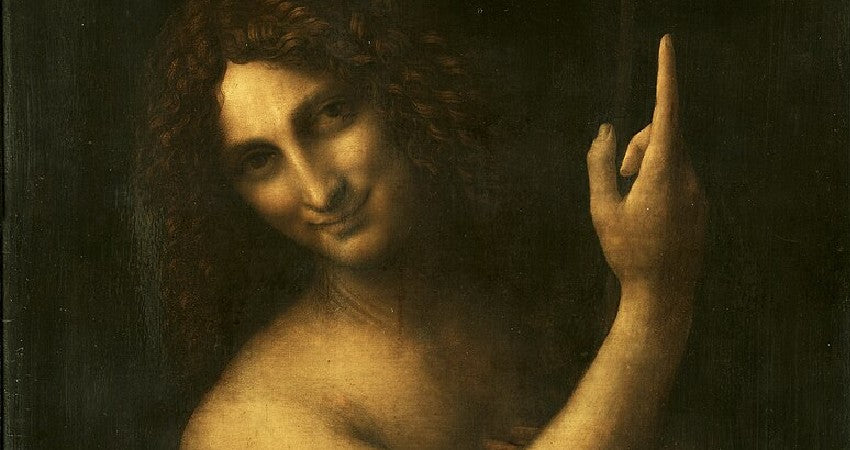
Saint John the Baptist by Leonardo: the master's last work
Alice PettirossoPresentation of the work: Saint John the Baptist by Leonardo da Vinci
Saint John the Baptist is an oil painting on walnut panel by Leonardo da Vinci, created during the High Renaissance, probably completed between 1513 and 1516. The work is generally considered the master's last painting, created during the period when he was at the court of Francis I of France. Measuring 69 x 57 cm, the painting is currently on display at the Musée du Louvre in Paris, like many other works by Leonardo, including the famous Mona Lisa.
Composition and iconographic innovation
The painting depicts Saint John the Baptist in solitude, a choice that breaks with the traditional representation of the saint. Previously, in fact, Saint John was often depicted as a thin and austere ascetic, immersed in natural settings or narrative scenes foreshadowing the baptism of Christ. Leonardo, instead, chooses to depict him in an isolated and almost timeless setting, an image that would profoundly influence other Renaissance artists such as Raphael and Giulio Romano, who created similar versions of a young and luminous Saint John the Baptist, immersed in strong chiaroscuro. This paradigm shift reflects Leonardo's desire to explore the psychology and spirituality of the saint in an intimate and mysterious way, rather than illustrating his life narratively.
Chiaroscuro and sfumato: Leonardo's mastery
Thanks to the use of chiaroscuro, a technique in which Leonardo excelled, the figure of Saint John seems to emerge from the darkness, giving the composition a strong sense of depth and drama. This use of light is not only intended to create volume, but also to suggest a symbolic contrast between divine light and the darkness of the earthly world. This technique had already been used with great effect in the Last Supper, where the play of light accentuates the emotions of the characters, but here it reaches a more intimate and contemplative quality.
Leonardo also uses his characteristic sfumato, a technique that allows him to blur the contours of the figure, eliminating sharp lines and creating a soft and fluid effect. This approach gives the saint's skin a delicate and luminous, almost ethereal appearance, evoking a spiritual dimension. The same technique can be observed in the enigmatic smile of the Mona Lisa and in the faces of The Virgin of the Rocks, where delicate shadows give the subjects an aura of mystery.
Symbolism and gestures
Saint John wears a fur garment, a reference to his ascetic figure in the desert, and holds a reed cross in his left hand, a symbol of his role as a precursor of Christ. With his right hand, however, he points to the sky in a gesture that Leonardo had already explored in the Burlington House Cartoon, where Saint Anne makes a similar gesture. This gesture becomes emblematic of the link between the earthly and divine worlds, emphasizing John's spiritual message, which pointed to the coming of the Messiah.
The enigmatic smile of Saint John, which recalls that of the Mona Lisa, is another crucial element of the work. Leonardo gives the saint an ambiguous expression that blends serenity and mystery. This smile has often been the subject of psychoanalytic and symbolic interpretations. Some scholars, such as Frank Zöllner, have suggested that Saint John's almost androgynous appearance reflects Leonardo's deliberate intention to explore themes of sexual identity and spirituality, in line with other works of the period such as the Salvator Mundi, in which the figure of Christ presents similar features.
Symbolic and critical resonance
According to the scholar Kenneth Clark, Saint John represents "the eternal question mark, the enigma of creation", reflecting Leonardo's philosophical meditations on the fundamental questions of human existence. This sense of unease is also present in the Last Supper, where the composition and the gestures of the apostles convey a psychological tension that is reflected in the quiet intensity of John the Baptist.
Furthermore, art historian David Barolsky has emphasized how the figure of Saint John, emerging from the darkness in an almost shocking way, represents an ambiguous balance between spirit and flesh, a theme that Leonardo often explores in his works, particularly in his anatomical studies and representations of the human figure. Also in works such as Leda and the Swan, Leonardo celebrates the beauty of the human body, while placing it in a mythological and spiritual context.

Dating and history of the work
The dating of the work remains a subject of debate among scholars. It was seen by Antonio de Beatis in Leonardo's workshop at Clos Lucé in 1517, providing a post quem date for its completion. However, some experts have hypothesized that the work may have been started as early as 1509, suggesting a long gestation period, a process typical of many of Leonardo's works, as he tended to work slowly and with great attention to detail, as in the case of the Last Supper and the Battle of Anghiari (a lost work).
Influence and artistic legacy
The innovative representation of Saint John as a young and isolated figure profoundly influenced subsequent art. Raphael and his workshop produced several versions of Saint John that echo Leonardo's approach, especially regarding the contrast between the illuminated figure and the dark background. This new treatment of the subject moved away from medieval and Gothic representations of John as an ascetic hermit, bringing it closer instead to a Renaissance vision of humanity and spirituality.
Finally, numerous copies and variants of this Saint John the Baptist made by the so-called Leonardeschi (Leonardo's followers) are known today. These disciples, such as Francesco Melzi and Giovanni Antonio Boltraffio, adopted and reinterpreted many of the distinctive characteristics of Leonardo's style, contributing to the spread of his influence in 16th-century art.
The structure of the work
Central and isolated composition
Saint John the Baptist is depicted as a single figure, isolated against a completely dark background. This compositional choice creates a strong contrast between the figure and the background, highlighting the subject without distractions. The saint's position is frontal, but slightly turned, with a serene expression and a slight enigmatic smile that recalls the Mona Lisa.
Symbolic gestures
One of the central elements of the compositional structure is Saint John's gesture, raising his right hand pointing to the sky. This gesture has a religious and symbolic meaning, alluding to divinity and the spiritual message that Saint John preached. The saint's left hand holds a reed cross, a traditional iconographic attribute of the saint, which reinforces his role as a precursor of Christ.
Use of chiaroscuro
Leonardo uses chiaroscuro to make the figure emerge from the surrounding darkness, creating a gradual transition between the deep shadows of the background and the illuminated parts of the saint's body. This gives the figure a three-dimensional volume, creating the impression that Saint John is emerging from the darkness in a natural and realistic way.
Sfumato technique
The sfumato, characteristic of Leonardo, is particularly evident in the contours of Saint John's face and hands. The lines are deliberately blurred to avoid sharp outlines, giving a soft and delicate appearance to the skin and facial details, such as the eyes and lips. This technique contributes to the sense of mystery and ambiguity, as the figure almost seems to dissolve into the surrounding shadow.
The androgynous appearance
The representation of the saint has an almost androgynous quality, with delicate features and luminous, smooth skin. This appearance is reinforced by the use of sfumato and an ambiguous representation of the figure's sexuality, which has led to various symbolic and psychological interpretations of the work.
Symbolic lighting
The light in the composition does not come from a specific source, but seems to envelop the figure in a halo of spirituality. This type of lighting emphasizes the idea that Saint John is a divine figure, with the light symbolizing grace and spiritual revelation.
The painting technique
The painting technique used by Leonardo da Vinci in Saint John the Baptist is emblematic of his mature style and masterfully utilizes some of the technical innovations that made him one of the greatest masters of the Renaissance. The main painting techniques adopted in this work are chiaroscuro and sfumato, combined with a careful use of materials.
Chiaroscuro
Chiaroscuro is a technique that Leonardo uses to create a strong contrast between light and shadow, giving the figure of Saint John a sense of three-dimensionality and depth. In Saint John the Baptist, the saint emerges from the dark background in an almost dramatic way, as if illuminated by a hidden light source. This contrast between the illuminated and shadowed parts helps to highlight the figure, creating a theatrical effect that focuses the viewer's attention on the subject.
Sfumato
Sfumato is one of Leonardo's most distinctive techniques, consisting of making the transitions between areas of light and shadow very gradual, without sharp outlines. In Saint John the Baptist, this technique is especially evident in the saint's face, hands, and hair curls. Leonardo uses sfumato to delicately blur the edges of the figure, avoiding sharp lines, creating a soft and realistic effect. This contributes to giving the figure an almost ethereal appearance, as if it were emerging naturally from the surrounding darkness.
Use of light
The lighting is managed so as not to come from a specific light source, but rather appears diffused and delicate. This light seems to envelop the figure of the saint, accentuating the sense of spirituality and sacredness. The saint's face and body are slightly illuminated, with a luminous quality that enhances the softness of the features and the delicacy of the skin, rendered in an almost translucent way.
Surface treatment
The painted surface is treated with extreme attention to detail. Leonardo applied multiple very thin layers of paint to create a smooth and velvety texture. This layering technique, typical of Leonardo, allows light to penetrate the various layers of color, giving the saint's skin an internal luminosity that makes the figure even more alive and vibrant.
Materials used
The painting is made with oil on walnut panel, a harder surface than the traditional poplar panels Leonardo used in other works. The use of oil allows for more delicate and soft nuances than tempera, and this technique allows for the layering of thin glazes, creating effects of transparency and depth. Oil also allows for slow and careful work, which suits Leonardo's style well, known for its slow pace and continuous search for perfection.
Treatment of expressions and details
The enigmatic expression of Saint John, with a slight smile that recalls that of the Mona Lisa, is made possible by the fusion of chiaroscuro and sfumato. The details, such as the thin and curly hair, are also rendered with great meticulousness, utilizing the oil technique to create luminous highlights that give depth and realism to the hair. The hands, especially the one pointing towards the sky, are also treated with great attention, using sfumato to soften the contours and create a natural effect.
Androgynous effect
The softness and delicacy of the shadows and lights, together with the lack of sharp boundaries, contribute to creating an ambiguous, almost androgynous figure that has sparked many interpretations. This stylistic choice, achieved through sfumato and chiaroscuro, enhances the spirituality of the subject while also increasing its mystery, blending the idea of spirit and flesh into a single image.
Curiosity
Leonardo's last work
Saint John the Baptist is traditionally considered Leonardo da Vinci's last completed work. It was completed shortly before his death, during his stay in France, and represents the artist's maturity and full mastery of painting techniques, in particular sfumato and chiaroscuro.
Ambiguity and androgynous representation
One of the most discussed characteristics of the painting is Saint John the Baptist's androgynous appearance. The saint is depicted with delicate, almost feminine features, which has led many scholars to speculate on the possible symbolic or personal meaning Leonardo may have intended to include in the work. Some have seen in this representation an expression of the artist's alleged homoerotic inclinations.
The enigmatic smile
Saint John the Baptist's smile has often been compared to that of the Mona Lisa, both for its ambiguous expression and for the way it was rendered using the sfumato technique. This enigmatic smile, common in other works by Leonardo, has given rise to numerous interpretations regarding the spiritual or philosophical message the artist intended to convey.
Influence on other artists
Leonardo's representation of Saint John the Baptist in this version profoundly influenced other Renaissance artists. In particular, Raphael's and Giulio Romano's workshops created works that featured the young and isolated John, with strong contrast between light and shadow. This represents a clear departure from previous representations of the saint, which depicted him as a thin and austere ascetic.
Royal property and exchanges between monarchs
Saint John the Baptist has had an interesting history among royal collections. In 1625, the painting was exchanged between Louis XIII of France and King Charles I of England. Charles received the work in exchange for a work by Titian and a portrait of Erasmus by Holbein. After the death of Charles I and the sale of his collection, the work passed through various hands, including the banker Eberhard Jabach and Cardinal Mazarin, before returning to the French royal collection with Louis XIV.
Symbolic interpretation
According to some scholars, including Kenneth Clark, Saint John the Baptist in this painting represents “the enigma of creation,” and the figure seems to embody an eternal question mark, a symbol of existential doubt and uncertainty. This sense of ambiguity and mystery is accentuated by the saint’s gestures and ambivalent expression.
Hidden details and similarities with other works
Saint John’s posture, with his right hand raised and pointing toward the sky, is similar to Saint Anne’s gesture in the Burlington House Cartoon. This particular gesture has been interpreted as a spiritual statement, alluding to divinity and salvation, but it also has a strong aesthetic impact, linking this painting to other key works by the master.
Numerous copies and variations
As with many of Leonardo’s works, Saint John the Baptist was the subject of numerous copies and variations, particularly by the Leonardeschi, Leonardo’s followers and disciples. These pupils created several versions and adaptations of the work, reflecting the strong influence the painting had on the art of the period.
State of preservation
Thanks to Leonardo’s meticulous painting techniques and the solid walnut wood panel, the painting has been preserved in excellent condition despite its age. However, some technical analyses have revealed the presence of later touch-ups, which were probably carried out during the work’s various changes of ownership.